
Fire Pit Ideas: 10 Natural Stone Designs for Australian Backyards

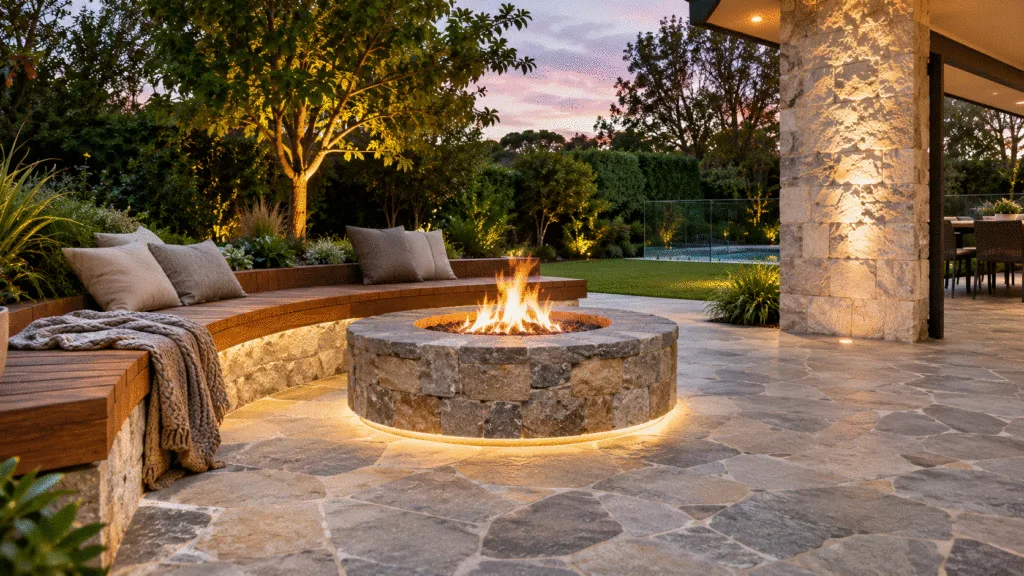
A fire pit is one of the simplest ways to get more out of a backyard. On a cool Melbourne evening it draws everyone outside, gives the garden a natural gathering point and turns a plain paved corner into somewhere people actually want to sit. The best fire pit ideas start with the space around the flame: a level stone base, seating at a comfortable distance, and walls or paving that tie the area back to the house and garden.
The short answer: put your fire pit well clear of the house, fences and trees, set it on a level, non-combustible base such as natural stone paving, line any built pit with firebrick or a steel insert, and check the CFA and council rules before you light it. Below are 10 natural stone designs, the stones that suit each part of a fire pit area, how a built pit goes together, and what the Victorian rules say.
In this guide
What Makes a Good Fire Pit Area?
A good fire pit area is level, sheltered from strong wind, clear of anything that can catch fire, and paved with a hard surface that’s easy to sweep. Get those four things right and almost any style will work.
Placement comes first. Keep the pit away from the house, timber decks, fences, overhanging branches and pergolas, and think about where the smoke will drift on your usual evening breeze. Smoke drifting into a neighbour’s yard is the quickest way to turn a fire pit into a complaint, so a spot that suits the prevailing wind matters as much as a spot that looks good.
Then plan the seating and the surface together. Built-in seat walls give a permanent, tidy edge and free up space, while loose chairs suit smaller yards that need to do other jobs. Natural stone paving extends the safe zone around the fire, because it doesn’t burn when a spark or ember lands, and it gives the area a defined shape so it reads as an outdoor room rather than a patch of lawn.
10 Stone Fire Pit Ideas for Australian Backyards
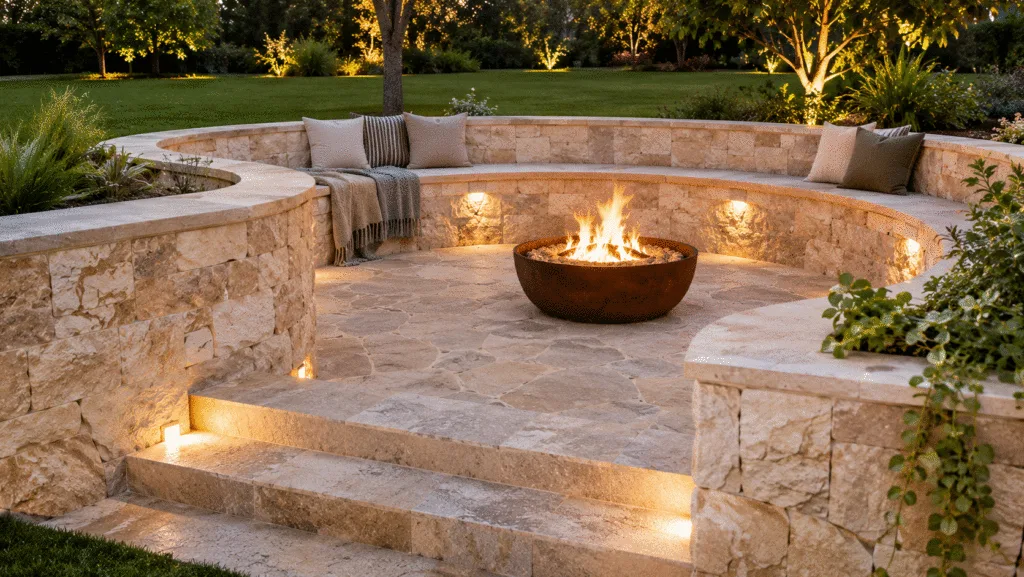
These ideas run from a weekend project to a full landscape build. Most combine three elements: a paved pad, a fire pit (built or freestanding) and some form of stone seating or backdrop.
1. A Sunken Fire Pit Lounge
Dropping the fire pit a step or two below the garden creates a sheltered, intimate space that blocks wind and feels enclosed. It works especially well on a sloping block, where the cut into the slope gives you the walls for free.
The walls around a sunken lounge do two jobs. They hold back the soil, and their tops become seating. On a slope they’re effectively stone retaining walls, so they need proper footings and drainage behind them, and the paved floor needs a drain or a fall so rainwater doesn’t pool around the fire.
2. Curved Stone Seat Walls Around the Pit
A low, curved seat wall wrapped around part of the fire pit gives you permanent seating without crowding the space with furniture. Leave an opening on one side so people can walk in, and add cushions on the cap for comfort.
Seat walls are usually a masonry core with natural stone cladding on the faces. Warm, textured stones such as Beloka or Jamieson from the limestone wall cladding range suit relaxed, garden-style designs, while a flat stone cap on top gives a clean place to sit.
3. A Stone-Clad Column or Blade Wall Beside the Fire
A single tall stone element next to the fire pit gives the area a focal point, some privacy and a little wind protection. It also anchors the fire pit visually, so it doesn’t float in the middle of the yard.
In The Stone Spine project, a Buffalo granite column stands beside the fire pit and a curved timber bench, carrying the same stone used on the blade wall at the front of the house. Repeating one stone from the street to the backyard is an easy way to make a fire pit feel like part of the architecture.
4. A Crazy Paving Fire Pit Pad
Irregular stone pieces suit fire pit areas with a relaxed, natural feel, and they work well in curved or freeform layouts. Circular pads are easier to shape with random pieces than with rectangular pavers, which need more cutting.
Crazy paving in travertine, bluestone, porphyry or marble also makes everyday marks less noticeable than on large, plain pavers, which is useful in an area that gets sooty.
5. A Square, Modern Fire Pit in Stacked Stone
A crisp square or rectangular fire pit clad in stacked stone suits contemporary homes with flat roofs, black window frames and simple planting. Keep the lines tight and the cap flat.
The steely greys of Blue Ridge quartz, or the charcoal greys running through Kakadu, look sharp in stacked stone cladding, and the split-face texture catches the firelight after dark. Keep in mind that darker stone absorbs more sun, so it can feel warm to sit on during hot afternoons.
6. A Freestanding Fire Bowl on a Stone Terrace
A freestanding steel fire bowl on an existing stone terrace is the simplest option of all. It needs no construction, you can move it to suit the season, and it’s ideal if you rent or haven’t settled on a permanent layout.
What matters here is the surface under the bowl. Dense paving such as granite or bluestone shrugs off ash, and a penetrating sealer makes soot and food spills easier to lift. Place a heat-resistant mat or stand under the bowl if the manufacturer recommends one.
7. An Outdoor Fireplace or Chimney Instead of an Open Pit
If smoke drifting across the yard is a concern, an outdoor fireplace with a chimney is the more contained alternative. The flue carries smoke up and away, and the fireplace wall becomes a backdrop for a sitting area.
At Beloka by the Bay, Beloka limestone clads a tall outdoor wood-fire chimney with a full-height log store, alongside a built-in barbecue bench. Splendour In Stone supplies and installs natural stone outdoor fireplaces across Melbourne and regional Victoria, and the fireplace unit goes in before the stonework starts.
8. Built-In Log Storage
A log store built into a stone seat wall or chimney keeps firewood dry, close at hand and neatly stacked. It’s a practical detail that also looks good, because the stacked timber end grain contrasts well with split-face stone.
Raise the base of the store off the ground so water can’t wick into the wood, and leave it open at the front for airflow.
9. A Gravel Fire Pit Garden with Stepping Stones
A circle of compacted gravel with stone stepping pavers leading to it is a low-cost fire pit area with a soft, garden look. Gravel drains freely and doesn’t burn, and the steppers give a clear route through the planting.
Space the steppers to suit a normal walking stride, and bed them firmly so they don’t rock. A path that’s comfortable in daylight can feel awkward in the dark if the gaps are uneven.
10. A Fire Pit with a Cooking Grate
Adding a swing-arm or removable grate turns a fire pit into a wood-fired cooker for flatbreads, skewers and slow-cooked pots. It’s a good fit for households that would rather cook over coals than gas.
A stone fire pit with a grate is one of the simpler stone BBQ ideas to build, because it uses the same structure as a standard pit. Leave a little bench space nearby for plates and tools.
Which Stone Works Best Around a Fire Pit?
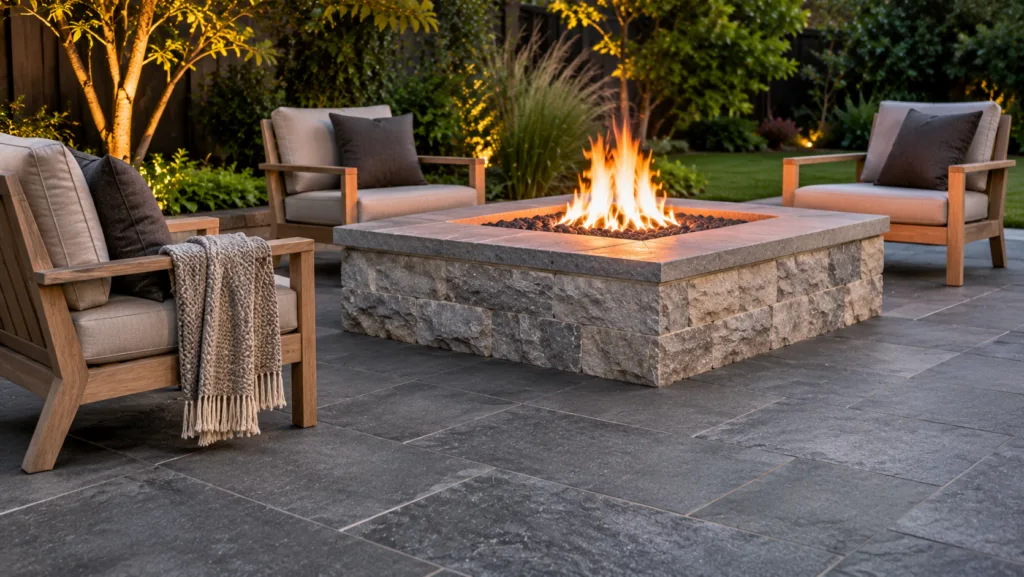
Dense, textured stones suit fire pit areas best: granite or bluestone for the paving, and split-face granite, quartz, sandstone or limestone for the walls and seats. Stone of any kind belongs on the outside of the pit, with firebrick or a steel insert taking the direct heat inside.
| Part of the fire pit area | What matters most | Stones from the SIS range that suit |
|---|---|---|
| Paving pad | Easy to sweep, resists staining from ash, soot and food, firm underfoot | Granite pavers (Charcoal, Grey), Flamed or Sawn bluestone, sealed limestone such as Berkshire |
| Seat walls and surrounds | Rated for outdoor walls, weathers well, comfortable top | Split-face cladding: Buffalo or Hotham granite, Charlotte sandstone, Beloka or Jamieson limestone, Blue Ridge or Kakadu quartz |
| Inside the fire bowl | Takes direct flame and high heat | Firebrick or a steel fire pit insert, not decorative cladding |
For the paving, granite pavers are a strong choice because granite is one of the least porous natural stones, so ash, oil and food are less likely to soak in. Flamed bluestone is another good option, with a heavily textured surface that gives strong grip.
For the walls, most of the SIS walling range is listed for facades and outdoor walls. Kakadu quartz, with its rusted reds, golds and charcoal greys, is one that SIS describes specifically for outdoor fireplaces and garden walls. If you’re still deciding between materials, natural stone and brick for fire pits each have trade-offs in heat performance, cost and look.
How to Build a Stone Fire Pit That Lasts
A long-lasting built fire pit has three layers: a solid, level base, a heat-resistant inner lining and natural stone cladding on the outside. Skipping either the lining or the base is a common cause of cracked cladding and caps working loose.
- Check the rules and choose the spot. Confirm council and CFA requirements for your address before you build, and pick a position well clear of buildings, fences and trees.
- Prepare a level, well-drained base. A built pit needs a solid footing, and the surrounding paving needs a fall so water runs away from the fire.
- Build the core. The structure is usually concrete block or masonry, sized to suit your insert or firebrick lining.
- Line the fire bowl. Use firebrick set in a heat-resistant mortar, or a purpose-made steel ring, so the flame never sits directly against the cladding.
- Clad the outside in natural stone. Walling can be laid dry stack for a tight, contemporary finish or grouted for a more traditional look, and matching corner pieces keep the edges looking solid.
- Pave the surround. Extend the paving well past the pit so sparks and embers land on stone, not grass or mulch.
- Seal the stone. A penetrating sealer helps the paving and cladding resist soot, ash and food stains.
Natural stone suits the outside of a fire pit, but it isn’t fireproof. Ordinary masonry can crack or break apart when moisture trapped inside it heats and expands quickly, which is why fire safety guidance recommends lining permanent masonry fire pits with firebrick. For the same reason, don’t fill the bowl with river rocks or stones that have been sitting in water.
Fire Pit Rules in Victoria
In Victoria you can’t light a fire pit, brazier or chiminea on a Total Fire Ban day, and during the Fire Danger Period you can only use one if you follow CFA’s conditions. Total Fire Bans are declared by fire weather district, and they include Melbourne’s Central district, so they apply in the suburbs too.
The Fire Danger Period applies to country Victoria and the outer metropolitan suburbs of Melbourne, and CFA declares it council by council. While it’s in force, CFA allows a fire pit for warmth or comfort only when all of these conditions are met:
- A proper fireplace: a properly built fireplace of stone, metal or concrete, or a commercially made fire pit, chiminea or brazier.
- Size: the fire is no larger than one square metre.
- Clearance: the area 3 metres around and above the fire is clear of anything that can burn.
- Wind: the wind is under 10 km/h.
- Supervision: someone stays with the fire the whole time it’s alight, with the means to put it out.
- Putting it out: the fire is fully extinguished with water before you leave it.
CFA also recommends keeping a hose or 10 litres of water nearby whenever a fire is lit. Check CFA’s Can I or Can’t I page for current dates in your area before the season starts, because Fire Danger Period dates change every year.
Councils add their own layer through local laws, mostly about smoke. Knox City Council, for example, requires that smoke, soot, ash and odours from a fire don’t cause a nuisance, and smoke complaints between neighbours are handled by councils rather than the EPA. Check your council’s rules on burning and smoke before the first cool night of the season.
Caring for Stone Around a Fire Pit
Sweep up cold ash after each use, wash the stone with water and a pH-neutral stone cleaner, and reseal on a regular cycle. Ash left to sit through rain can leave grey marks that are harder to lift later.
Avoid acid-based cleaners and harsh chemicals, which can etch limestone, travertine and marble and damage the sealer on any stone. For soot on wall cladding, a soft brush and a pH-neutral cleaner usually do the job.
SIS recommends resealing outdoor paving every two to three years, with high-use areas at the shorter end of that range, and a fire pit pad counts as high-use. The guide to sealing outdoor pavers covers how to tell when the protection has worn.
When you’re ready to choose stone, the Splendour In Stone showroom in Mitcham is set up to view most walling at wall scale, and samples of up to four stones are posted free Australia-wide. Send rough measurements and a photo of the space, and the team puts together a written quote within 24 hours.
Frequently Asked Questions About Fire Pits
What is the cheapest way to make a fire pit area?
The cheapest option is a freestanding steel fire bowl on a gravel pad or existing paving. It needs no construction, and you can add stone seat walls or paving later as the budget allows.
What do you put at the bottom of a fire pit?
For a built fire pit, line the bowl with firebrick or fit a purpose-made steel insert, so the flame never sits directly against the masonry. Make sure the base drains so rainwater doesn’t sit in the pit, and don’t fill it with river rocks or stones that have been in water, which can crack when heated.
Where should you not put a fire pit?
Don’t put a fire pit under trees, eaves, pergolas or shade sails, or close to fences, timber decks, sheds or the house. Avoid spots where the usual breeze will push smoke straight into your home or a neighbour’s.
Can you use natural stone for a fire pit?
Yes, natural stone is well suited to fire pit surrounds, seat walls and paving, as long as the inside of the pit is lined with firebrick or a steel insert. The lining takes the direct heat, and the stone cladding gives the pit its look.
Do you need permission for a fire pit in Victoria?
It depends on the day and where you live. Fire pits can’t be lit on Total Fire Ban days. During the Fire Danger Period in country and outer metropolitan areas, CFA’s conditions apply, including 3 metres of clear space around and above the fire. Councils also set local laws on burning and smoke, so check with yours.
Does stone paving get hot around a fire pit?
Paving close to the fire warms up while it’s burning, and dark stone also heats up in direct sun. Lighter stones stay cooler on summer afternoons, which is worth weighing up if the area doubles as a sunny daytime terrace.