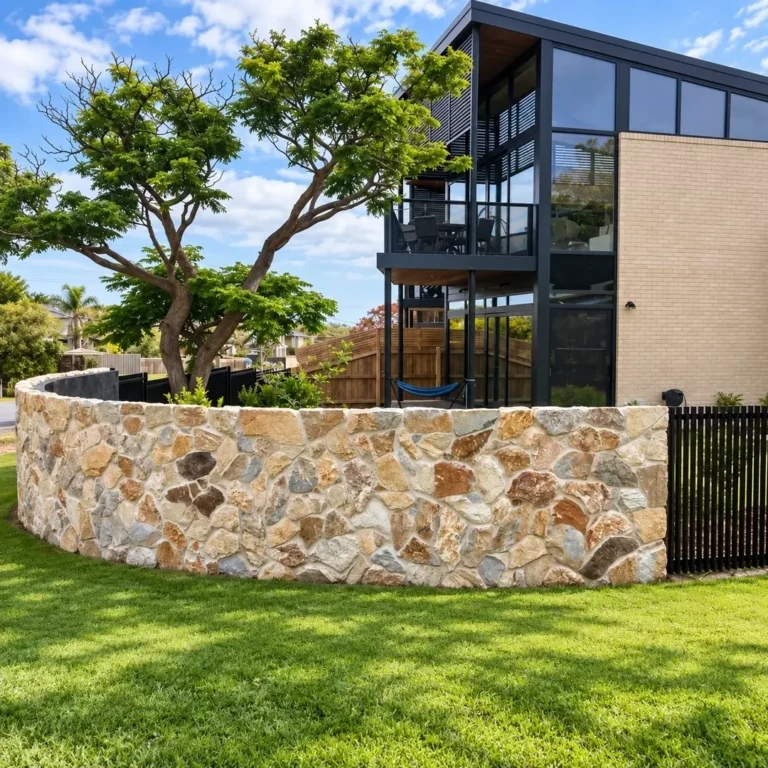
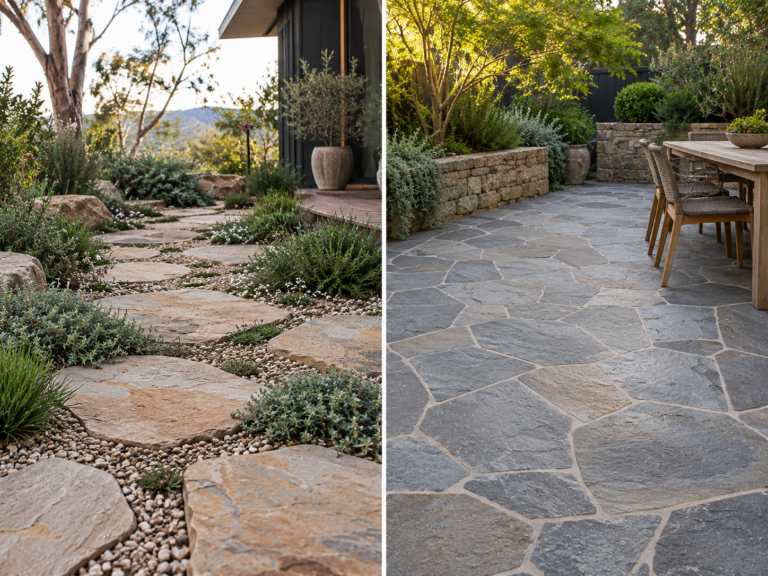
Choosing between natural stone vs porcelain for outdoor paving is one of the trickier calls in any backyard project. The decision shapes how the space looks, feels underfoot and ages over time.
Both materials promise durability. Both look great in showroom samples. The real test is how they perform once they’re sitting under the Australian sun, salt air or pool splash for years.
This guide compares them honestly across cost, comfort, safety and longevity. By the end, you’ll know exactly which one suits your home, your climate and the way you actually use the outdoors.
Before the comparison, here is the simplest way to think about natural stone paving and where it fits.
What Is Natural Stone Paving?

Natural stone paving is a solid material quarried directly from the earth, then cut and finished into pavers for outdoor use. It is shaped by geological pressure over millions of years, not by manufacturing, which means each piece carries its own colour, veining and texture.
That natural variation is what gives stone its character. Pavers settle into the landscape rather than sitting on top of it, and they tend to look better the longer they’re in the ground.
Natural stones commonly used for outdoor paving include:
- Travertine: stays cool underfoot, popular for pool surrounds and entertaining areas
- Limestone: soft tones with reliable slip resistance, suits classic and modern designs
- Granite: dense and chlorine-resistant, ideal for pool zones and driveways
- Bluestone: dependable grip, suits coastal and urban paving alike
- Sandstone: warm character, works well for paths, patios and feature walls
- Quartzite: hardwearing with a bright finish, suits luxury pool surrounds
Porcelain takes a different route to a similar outdoor finish, and the production process is where most of the differences start.
What Is Porcelain Paving?
Porcelain paving is a manufactured paver made from refined clay, minerals and additives, fired at extremely high temperatures. The result is a dense, hardwearing tile designed to handle outdoor wear, water and weather without absorbing moisture into the surface.
The production process is what gives porcelain its consistency. Raw materials are pressed into shape, then fired at temperatures above 1200 degrees Celsius. Glazing is sometimes added for colour or texture. The finished paver is uniform across the batch, which suits projects that need a tight, predictable visual outcome.
Key characteristics of porcelain pavers include:
- Composition: clay-based, fired at extreme heat for a dense, low-porous finish
- Finish: non-porous and naturally stain resistant, no sealing required
- Consistency: uniform colour and pattern across the entire batch
- Format: lightweight tiles in standard sizes, easier to handle on retrofits
These are the differences that actually matter once the samples leave the showroom and the pavers go down on site.
How Does Natural Stone Compare to Porcelain for Outdoor Paving?
Both materials can deliver an excellent outdoor surface. The split shows up in how they handle heat, traffic, water and time. The table below maps the differences side by side.
| Feature | Natural Stone | Porcelain |
| Origin | Quarried from earth | Manufactured from fired clay |
| Appearance | Unique veining, natural variation | Uniform colour and pattern |
| Heat underfoot | Cooler in direct sun | Hotter in peak summer |
| Slip resistance | Strong, naturally textured | Good with textured finish only |
| Porosity | Variable, sealing often needed | Non-porous, no sealing |
| UV stability | Excellent on dense stone | Excellent across most products |
| Weather durability | Strong with correct stone choice | Strong across all conditions |
| Maintenance | Periodic sealing and cleaning | Cleaning only |
| Lifespan | Decades, ages gracefully | Heavier, skilled labour is required |
| Installation | Heavier, skilled labour required | Lighter, simpler retrofit |
| Cost | Higher upfront on premium stones | Lower upfront in most cases |
| Resale value | Premium, lifts property value | Functional, modest lift |
The right pick depends on three things: where the paver lives, what it has to put up with, and how much maintenance you’re willing to take on. The next sections break that down properly.
Here is what natural stone pavers do well outdoors, and where they make life harder.
What Are the Pros and Cons of Natural Stone Pavers?

Natural stone pavers earn their price tag in two areas: comfort underfoot and authentic character. The trade-off lives in maintenance and supply variability. Most projects that go wrong with natural stone get tripped up on the second list, not the first.
Pros of natural stone pavers:
- Stays cooler underfoot: comfortable for bare feet during peak summer
- Natural slip resistance: textured surface holds grip when wet
- Authentic character: every paver carries unique veining and tone
- Long lifespan: ages gracefully and develops a natural patina
- Strong resale value: seen as a premium feature in landscaping
- Recyclable and reusable: can be repurposed without losing quality
Cons of natural stone pavers:
- Higher upfront cost: quarrying and transport push the purchase price up
- Needs sealing: porous types like limestone and sandstone require regular sealing, so understanding porous stone helps you plan maintenance properly.
- Variable supply: colour and finish can shift between batches, which complicates reorders
- Heavier handling: requires skilled installation and proper substrate preparation
- Some types weather faster: sandstone can chip or erode over time
In our experience, the surprises rarely come from the slab itself. They come from the sealing schedule, the substrate prep and the difficulty of matching new pavers to old ones years down the line.
Porcelain solves a different set of problems, and that flips the strengths and weaknesses almost in reverse.
What Are the Pros and Cons of Porcelain Pavers?
Porcelain earns its place when low maintenance, consistent appearance and tight modern lines matter more than authentic variation. The shortcomings show up underfoot in summer and around water unless the finish is right.
Pros of porcelain pavers:
- Non-porous surface: strong stain, mould and algae resistance with no sealing
- Low maintenance: clean with water and mild detergent, that’s the routine
- Consistent appearance: uniform colour and pattern across the entire project
- UV stability: holds colour reliably under sustained Australian sun
- Lightweight format: simpler installation, especially on retrofits
- Lower upfront cost: generally cheaper than premium natural stone
Cons of porcelain pavers:
- Hotter underfoot in summer: can become uncomfortable during peak heat
- Slipperier when wet: unless a textured grip-rated finish is specified
- Less character: pattern repetition shows up across larger areas
- Hard to repair: chips and cracks rarely patch invisibly
- Lower resale lift: seen as functional rather than premium
- Brittle on impact: dropped pots and heavy furniture can crack thinner pavers
The pattern is consistent. Porcelain is a strong outdoor paver with very specific weak points around heat, slip risk and visual repetition.
This is where Australian conditions decide a lot of the argument. Sun, salt and rainfall have a real say in which paver lasts.
How Do Natural Stone and Porcelain Perform in Australian Conditions?
Climate is rarely an even playing field for outdoor pavers. UV intensity, coastal salt air and seasonal rainfall all shape how a material ages, and the differences between stone and porcelain show up most clearly outdoors.
Heat and UV Exposure
Natural stone, especially travertine and limestone, stays noticeably cooler underfoot than porcelain. That matters for pool sides, entertaining areas, and any space with bare feet in summer, which is why travertine for pool coping remains such a practical option in exposed outdoor zones.
Porcelain holds colour exceptionally well under UV, which is its strongest outdoor advantage. The trade-off is that porcelain absorbs heat faster and releases it more slowly, so it can be uncomfortable in the middle of January.
Coastal and Salt Air Exposure
Granite and quartzite handle coastal salt air strongly thanks to their density and mineral structure. Porcelain also performs well in salt air because the non-porous surface refuses to absorb anything. Both materials suit Australian coastal builds, though sealing requirements differ. Sandstone and softer limestones need more frequent sealing in salt-exposed locations.
Rainfall and Drainage
Both materials perform reliably with proper substrate and drainage design, which is a more important variable than the paver itself. Porcelain’s low porosity handles puddling slightly better in wet zones, while natural stone needs a sealing routine in heavy-rainfall areas. A proper permeable paving strategy can also help manage water movement before it affects the surface.
Pool and Wet Area Safety
Natural stone holds an edge for slip resistance through naturally textured surfaces. Travertine and bluestone are particularly reliable around pools. Porcelain works in wet zones if a textured or grip-rated finish is specified, but a smooth porcelain paver around a pool is a safety risk that’s easy to miss at the spec stage.
Stone choice matters as much as the stone-versus-porcelain decision itself. Here are the picks that hold up best around Australian outdoor spaces.
Which Natural Stones Work Best for Outdoor Paving?
Not every natural stone suits every outdoor application. The five below cover most pool surrounds, patios, paths and driveways across Australian conditions.
Travertine
Travertine stays naturally cool, offers a strong grip and brings a soft, elegant look to pool surrounds. Its light tones brighten outdoor spaces and work well across modern, classic and coastal designs. Classic travertine and silver travertine are the most popular picks for their calm, light-reflecting palette.
Limestone
Limestone suits families who want comfortable surfaces underfoot during long summer days. Its subtle colour variation pairs well with lush gardens and contemporary homes. It also delivers dependable slip resistance once sealed. Loch limestone and Berkshire limestone are common picks, valued for their pale, refreshing finish around water.
Granite
Granite is firm, stable and resistant to chlorine and salt, which makes it ideal for high-traffic pool zones and driveways. Its speckled appearance adds visual interest without overwhelming the design. Charcoal Granite and Grey Granite are the standards for darker, architectural styles.
Quartzite
Quartzite combines mineral shimmer with outstanding surface hardness, making it an ideal choice for pool areas that need both luxury and resilience. It resists heat and surface marks exceptionally well. White Quartzite is admired for its bright, luminous finish that pairs beautifully with the blue of a pool.
Bluestone

Bluestone performs strongly around pools thanks to its density, cooling capability and dependable grip. The subtle colour variation suits coastal and urban designs alike, and options such as Flamed Bluestone are reliable picks for long-lasting style and outdoor performance.
Cost is rarely the only factor, but it’s the one most homeowners frame the decision around. Here is how the numbers actually compare.
How Much Do Natural Stone and Porcelain Pavers Cost?
Pricing splits across upfront cost, installation, ongoing maintenance and replacement frequency. The cheapest option per square metre is rarely the cheapest across twenty years.
Upfront Cost
Porcelain pavers typically come in lower per square metre than premium natural stone. Standard porcelain ranges sit comfortably below granite, quartzite or marble equivalents. Natural stone pricing varies more widely. Sandstone and limestone can be competitive with porcelain, while granite and quartzite sit clearly at the higher end.
Lifecycle Cost
Natural stone needs sealing every few years, plus occasional gentle cleaning. That adds cost over time but rarely changes the overall affordability picture. Porcelain skips the sealing line item entirely. Replacement is the bigger variable. Stone often outlasts porcelain in heavy-use outdoor areas, particularly around pools and driveways, which can shift the lifecycle maths.
Resale value also matters. Natural stone is widely seen as a premium landscaping feature, and buyers respond to it. Porcelain delivers solid functional value but rarely lifts a property’s perceived premium in the same way.
The right paver isn’t a matter of taste alone. A short framework, applied honestly, gets you to the right answer faster.
How Do You Choose the Right Paver for Your Outdoor Space?
Five filters cover most of the decision. Apply them in order. The first one usually settles half the call before cost or appearance even enters the conversation.
- Define the application: patio, pool surround, driveway, garden path or walkway. High-traffic and wet zones tilt toward natural stone. Sheltered patios and modern courtyards suit porcelain.
- Assess climate exposure: sun intensity, coastal salt, rainfall and traffic volume. Hot northern regions favour cooler stone underfoot. Coastal builds suits both materials with the right specification.
- Set a lifecycle budget: purchase, install, sealing, maintenance and replacement frequency over twenty years. Cheaper upfront is rarely cheaper across that window, especially when paver cleaning and maintenance is part of the long-term cost.
- Pick an aesthetic position: organic variation or modern uniformity. Natural stone delivers character that ages into the landscape. Porcelain gives controlled, consistent visual lines suited to contemporary architecture.
- Plan for safety: slip resistance and surface temperature for kids, pets and bare feet. Pool surrounds in particular need both grip and heat consideration, not just looks.
These are the recurring traps. They’re the mistakes that show up two summers in, when the budget for a redo has long since moved on.
What Mistakes Should You Avoid When Choosing Outdoor Pavers?
Most paver regrets come from one or two variables that should have been weighed earlier. These are the most common, and almost all of them are quick to check before signing a quote.
- Choosing on upfront price alone: lifecycle cost tells the real story over twenty years
- Ignoring slip resistance: wet pool decks and pathways need traction, not just style
- Specifying smooth porcelain in pool zones: a safety risk without a textured grip finish
- Forgetting heat underfoot: matters for kids, pets and any space with bare feet in summer
- Skipping the sealing schedule: porous natural stones stain quickly when neglected
- Mismatching pavers to surrounding materials: breaks landscape cohesion in ways that are hard to fix
- Underestimating substrate prep: poor drainage damages either material, fast
A good supplier will run through this list before quoting. If they don’t, ask them to. Fifteen minutes upfront saves a much bigger problem later.
Picking the Right Paver for Your Australian Outdoor Project
There is no clear winner here, only the right paver for the right space. Natural stone earns its premium where comfort, character and long-term resale matter most. Porcelain earns its place where consistency, low maintenance and a modern visual line take priority.
For pool surrounds, high-traffic patios and outdoor entertaining areas, natural stone usually wins on comfort and grip. For sheltered courtyards, contemporary builds and tight design briefs, porcelain delivers a clean, predictable result.
Want help picking the right paver for your project? Bring your plans, photos or site measurements to Splendour in Stone. We’ll walk you through samples, climate considerations and the pavers that suit your build. Get a free outdoor paving quote today.
Frequently Asked Questions
1. Are porcelain pavers cheaper than natural stone?
Porcelain pavers are usually cheaper upfront, especially compared to premium natural stones like granite or quartzite. The gap narrows once you factor in lifespan, replacement costs and resale value. Sandstone and limestone can be competitively priced with porcelain. Across twenty years, the cheaper option upfront is not always the cheaper option in total.
2. Do porcelain pavers get hot in the Australian sun?
Yes. Porcelain absorbs heat faster than natural stone and holds it longer, which can make pavers uncomfortable underfoot during peak summer. Lighter colours help, but they don’t eliminate the problem. For pool surrounds, entertaining areas and any space used by bare feet, travertine or limestone offer noticeably cooler surfaces.
3. Which is safer around pools, natural stone or porcelain?
Natural stone generally has the edge for pool safety thanks to its naturally textured surface. Travertine and bluestone are particularly reliable for grip when wet. Porcelain can be safe around pools, but only with a textured or grip-rated finish. A smooth porcelain paver around a pool is a slip risk that’s easy to overlook.
4. Do natural stone pavers need sealing?
Most natural stone pavers benefit from sealing, with porous types like limestone, sandstone and travertine requiring it more regularly. Sealing protects against staining, moss and weathering. Granite and quartzite are denser and need less frequent attention. The sealing schedule depends on the stone, the location and the level of exposure.
5. Which lasts longer outdoors, natural stone or porcelain?
Both materials can last decades when properly installed, but natural stone often outlasts porcelain in high-traffic and high-use zones. Granite and quartzite in particular hold up exceptionally well over time. Porcelain holds its appearance well but can be more vulnerable to impact damage. Substrate quality and drainage influence longevity for both.
6. Can porcelain pavers crack in extreme weather?
Quality porcelain pavers handle extreme heat, heavy rainfall and freeze-thaw cycles well. They are dense and low-porous, which limits weather-driven damage. Cheaper or thinner porcelain products are more vulnerable to cracking under impact or extreme temperature swings. Specification quality matters here as much as the material category itself.