Bluestone pavers are a dense basalt cut into flat units for paving, prized in Australia for their deep blue-grey colour, naturally cool tone underfoot, and the kind of durability that shrugs off heavy traffic and harsh weather. They turn up everywhere from inner-city courtyards to pool surrounds and heritage footpaths, and for good reason: few materials look as good while lasting as long.
This guide covers what bluestone actually is, the formats and finishes you can buy, where each one suits, how the pavers are laid, and how to keep them looking right. If you only take one thing from it, let it be this: the finish and the laying method matter as much as the stone, and they are the two things people most often get wrong.
What is bluestone?
Bluestone is the common Australian name for basalt, a fine-grained igneous rock quarried largely in Victoria. Its density is what gives it the durability bluestone is known for: it resists cracking, fading, and wear far better than most paving materials, and it holds its colour outdoors for decades.
The surface ranges from deep charcoal blue-grey to a softer grey, often with small natural pock marks (called catseyes or vesicles) that are a normal part of the stone, not a defect.
It is worth clearing up one point of confusion. “Bluestone” means basalt in Australia, but the same word refers to entirely different stones overseas (a dolomitic limestone in the United States, dolerite in the UK). On an Australian project, bluestone is basalt.
Types of bluestone pavers and formats
Bluestone is sold in several formats, and the right one depends on the job.
| Format | What it is | Best suited to |
| Pavers and tiles | Flat square or rectangular units, common sizes for patios and floors | Patios, courtyards, indoor floors, alfresco |
| Cobblestones (setts) | Small modular blocks | Driveways, laneways, heritage and feature areas |
| Pool coping | Edge pieces, often bullnosed or drop-face | Pool surrounds and edges |
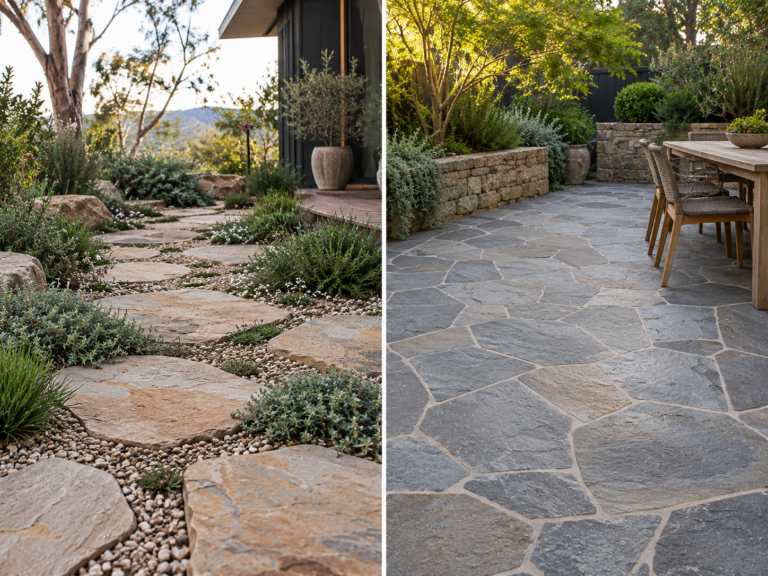
| Crazy paving | Irregular offcuts laid in a random fit | Organic paths, courtyards, rustic areas |
| Mesh-backed | Cobbles or pieces fixed to a backing sheet | Faster laying over large areas |
| Steppers / stepping stones | Large individual pieces | Garden paths, lawns, informal routes |
Sizes and thicknesses vary, and thickness in particular drives where a paver can go: thicker units handle vehicle loads, thinner calibrated tiles suit overlays and indoor floors. Always match the thickness and format to the load and setting, and confirm the exact dimensions against the supplier’s current range rather than assuming.
Bluestone finishes, and how they change everything
The finish changes the look, the feel underfoot, and the grip, so it deserves as much thought as the format.
1. Sawn
Cut faces with crisp, clean edges and a smooth, contemporary surface. The default for modern paving.
2. Honed.
Ground smooth to a flat, matte, refined face. Elegant indoors and on formal areas, but smoother underfoot, so think carefully before using it anywhere wet.
3. Flamed (thermal).
Heat-treated so the surface flakes to a textured, slightly rough finish with a strong grip. The go-to for pool surrounds and wet areas.
4. Exfoliated/sandblasted.
A lightly textured matte surface that adds grip without the roughness of flamed.
5. Tumbled.
Edges and surface softened for an aged, rounded, rustic look. Common on cobbles and in traditional settings.
| Finish | Look | Grip | Best suited to |
| Sawn | Smooth, modern, crisp edges | Moderate | General paving, courtyards |
| Honed | Smooth, matte, refined | Lower | Interiors, formal dry areas |
| Flamed | Textured, rugged | High | Pool surrounds, wet areas |
| Exfoliated | Lightly textured matte | Medium to high | Paths, outdoor living |
| Tumbled | Aged, rounded, rustic | Medium | Cobbles, heritage, character areas |
For anything around water or on a slope, lean toward flamed or exfoliated. Save honed for dry, formal, or indoor work.
Where to use bluestone pavers
Pool surrounds.
Bluestone stays cooler underfoot than many pale stones absorb less glare, and in a flamed or exfoliated finish, it grips well when wet, which is why it is one of the most popular pool materials in Australia.
Patios, courtyards and alfresco.
A natural fit. Sawn or exfoliated bluestone gives a clean, durable outdoor floor that ages well.
Driveways.
Use thicker pavers or cobblestones on a properly engineered base. Bluestone carries vehicle loads well when the build-up is right.
Paths and walkways.
Pavers, steppers, or crazy paving, depending on whether you want a formal run or an organic route through a garden.
Indoor floors.
Honed bluestone gives a refined, cool-toned floor that flows nicely from inside to a bluestone alfresco for a continuous look.
Heritage and commercial areas.
Cobblestones suit restorations, civic spaces, and high-traffic entries where durability and a sense of permanence matter.
How are bluestone pavers installed?
The method depends entirely on the load and the base. The principle: match the base to what the surface has to carry.
On a sand bed (pedestrian areas). Compacted crushed-rock base, a screeded sand bed, pavers set and tapped level, joints filled, edges restrained. Flexible and free-draining, ideal for patios and paths, but not for driveways on its own.
On a mortar bed or concrete (high-traffic, vehicular, or formal). Pavers bedded in mortar on a sound, well-draining concrete base. Rigid and permanent, the right call for driveways and anywhere you want zero movement. (Laying over an existing slab is its own job: the slab must be sound, draining, and the added height checked.)
On pedestals (balconies, podiums, terraces). Calibrated pavers on adjustable pedestals, where you need drainage or access beneath the paving.
Across all methods, three things decide whether the result lasts: a properly compacted base, correct fall for drainage (around 10mm per metre, running away from buildings), and firm edge restraint. Get those right, and most paving failures never happen.
Sealing and caring for bluestone pavers
Bluestone is low-maintenance, not no-maintenance. Sweep regularly and rinse with water; for grime, use a soft brush and a mild, pH-neutral detergent. Avoid acidic cleaners and high-pressure washing, which can mark the finish and disturb the joints.
Sealing is optional but recommended outdoors, especially in high-traffic or moisture-prone areas. A penetrating sealer helps resist staining, slows water uptake, and can deepen the natural colour.
One thing to know specific to bluestone: some flamed and exfoliated finishes can show a temporary white residue or lightening, which a sealer or simply weathering usually resolves. Reseal periodically based on exposure and traffic, and keep joints topped up so the pavers stay locked in place.
Choosing the right bluestone pavers for your project
Bluestone earns its reputation: durable, cool-toned, and good-looking in almost any setting, from a modern pool deck to a heritage laneway. The decisions that matter most are the finish (grip and look) and the laying method (matched to the load), so settle those against your specific job before you settle on a size.
If you want to see the finishes and tones in person, Splendour in Stone supplies bluestone pavers, cobbles, and coping across the range, with samples and advice on the right format for your project. Get in touch for a quote.
FAQs
1. Are bluestone pavers good for pool areas?
Yes, they are one of the most popular pool paving choices in Australia. In a flamed or exfoliated finish, bluestone grips well when wet and stays relatively cool underfoot compared with many pale stones. Avoid honed bluestone around a pool, since the smooth surface is more slippery when wet.
2. How much do bluestone pavers cost?
Cost depends on the format, finish, thickness, and quantity, plus delivery and whether installation is included. Flamed and cobble formats, and larger or thicker units, sit differently to standard sawn pavers. For an accurate figure, request a quote with your square metreage and preferred finish, and ask about current stock.
3. Do bluestone pavers get hot in the sun?
Bluestone is dark, so it absorbs heat like any dark surface, but it tends to feel cooler underfoot than many lighter stones that reflect glare, and a textured finish helps. For full-sun pool decks, a flamed or exfoliated finish is the comfortable choice, and a sealer does not change the temperature.
4. Do bluestone pavers need sealing?
Sealing is not essential but is recommended outdoors. A penetrating sealer helps bluestone resist staining and water uptake and can enrich the colour, which is worth it in high-traffic or wet areas. Indoors, sealing is optional but useful in kitchens or near water. Reseal periodically depending on exposure.
5. What is the difference between bluestone pavers and cobblestones?
Both are bluestone; the difference is format. Pavers are flat units for patios, floors, and pool surrounds. Cobblestones (setts) are small modular blocks suited to driveways, laneways, and heritage or feature areas, often in an interlocking pattern. Choose pavers for smooth, continuous surfaces and cobbles for traffic and character.
6. Can bluestone pavers be used indoors?
Yes. Honed bluestone makes a refined, cool-toned indoor floor, and running the same stone inside and out into an alfresco gives a seamless flow between spaces. Indoors, you can use smoother finishes safely, since slip is less of a concern away from water.