


French pattern travertine is a four-size paving layout built from a repeating set of six pieces: one 610 x 406 mm, two 406 x 406 mm, one 406 x 203 mm and two 203 x 203 mm. One set covers about 0.74 m², so a 20 m² alfresco needs around 31 sets once you allow for cuts.
This guide covers what the pattern is, the exact sizes in a set, how to work out your quantity, which thickness to choose, how the layout is set out and laid, and how it finishes against a pool edge.
What is French pattern travertine?
French pattern is a random-looking layout that repeats on a fixed set of four sizes. Laid correctly, the joints run in several directions and no long straight line forms across the area, which is what gives the floor its relaxed, European look.
It is the same pattern many suppliers sell as Versailles pattern, Opus Romano or a French set. The names are used loosely, so compare the piece sizes rather than the name when you are matching stone from two suppliers.
Travertine suits the pattern because its natural colour movement and small surface holes soften the joints between sizes. If you are new to the stone itself, our guide to what travertine is and how it performs covers its origin, properties and care.
What sizes are in a French pattern travertine set?
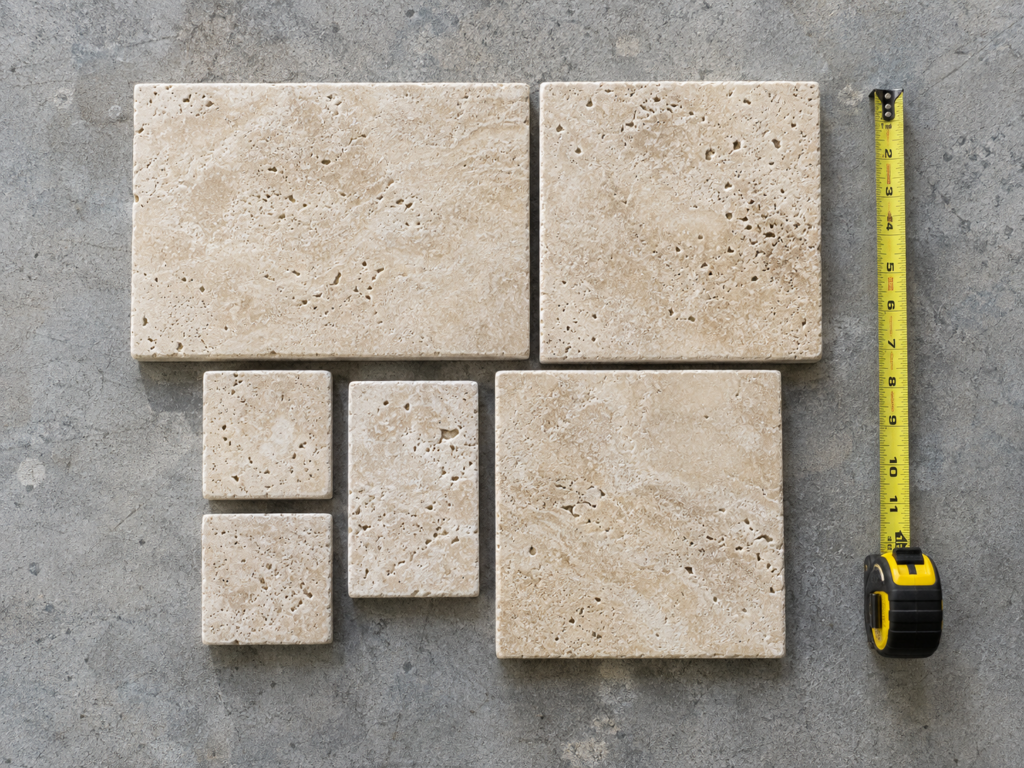
A standard French pattern set has six pieces in four sizes and covers about 0.74 m². The same composition is published by several Australian suppliers, including TFO and Design Tiles.
| Piece | Size (mm) | Pieces per set | Area per set (m²) |
|---|---|---|---|
| Large rectangle | 610 x 406 | 1 | 0.248 |
| Large square | 406 x 406 | 2 | 0.330 |
| Small rectangle | 406 x 203 | 1 | 0.082 |
| Small square | 203 x 203 | 2 | 0.082 |
| Total | 6 | 0.742 |
The full visual repeat takes two sets, or about 1.48 m². That is why suppliers quote coverage slightly differently: some pack one set as a unit (0.72 to 0.75 m²), others quote the two-set repeat (about 1.5 m², as Travertine Emporium does).
Sizes are built on a 203 mm module. Two small squares equal one small rectangle, two small rectangles equal one large square, and the large rectangle is one and a half large squares. That is what lets the pieces lock together without cutting inside the field.
Do not mix 610 x 406 sets with 600 x 400 sets. Some suppliers cut French pattern to a 600 x 400 mm module, and the two systems will not line up. Buy the whole area from one supplier and one batch.
How much French pattern travertine do you need?
Measure the area in square metres, divide by 0.74, add 15 percent for cuts and round up to the next whole set. Fifteen percent is the allowance Design Tiles recommends for French pattern, compared with the 10 percent often used for a simple straight lay, because a multi-size pattern produces more offcuts at the edges.
For example, a 5.0 x 4.2 m alfresco is 21 m². Add 15 percent and you need 24.15 m² of stone. Divide by 0.742 and round up: 33 sets, or about 24.5 m². If the area is L-shaped, curved, or wraps around a pool or steps, allow closer to 20 percent.
| Area to pave | Area with 15% allowance | Sets to order | Stone supplied |
|---|---|---|---|
| 10 m² | 11.5 m² | 16 | 11.9 m² |
| 20 m² | 23.0 m² | 31 | 23.0 m² |
| 30 m² | 34.5 m² | 47 | 34.9 m² |
| 50 m² | 57.5 m² | 78 | 57.9 m² |
| 80 m² | 92.0 m² | 124 | 92.0 m² |
Coping is counted separately from the paving, so measure the pool edge or step edges on their own. When you request a quote, send the paved area in m² and the coping length in metres, and the team will confirm the number of sets and coping pieces for your layout.
12 mm or 30 mm: which thickness suits your area?
Choose 12 mm for indoor floors and covered areas on a concrete slab, and 30 mm for outdoor paving and pool surrounds. SIS lists French pattern in both thicknesses for its Ivory, Cashmere, Classic and Silver travertine, so the choice comes down to where the stone is going and what it is laid on.
The 12 mm format is a tile. It is glued to a flat, sound slab or screed, which keeps floor build-up low, and it is the usual choice for living areas, entries and alfresco slabs under a roof. The 30 mm format is a paver. It is heavier, handles outdoor exposure and foot traffic better, and is the standard for patios, courtyards and pool decks, whether laid on a slab or on a prepared base.
If you are paving over an existing concrete area, our guide to laying pavers over concrete covers levels, drainage and door thresholds. For a new outdoor area without a slab, the paver base materials guide explains the sub-base options.
How to set out and lay French pattern travertine
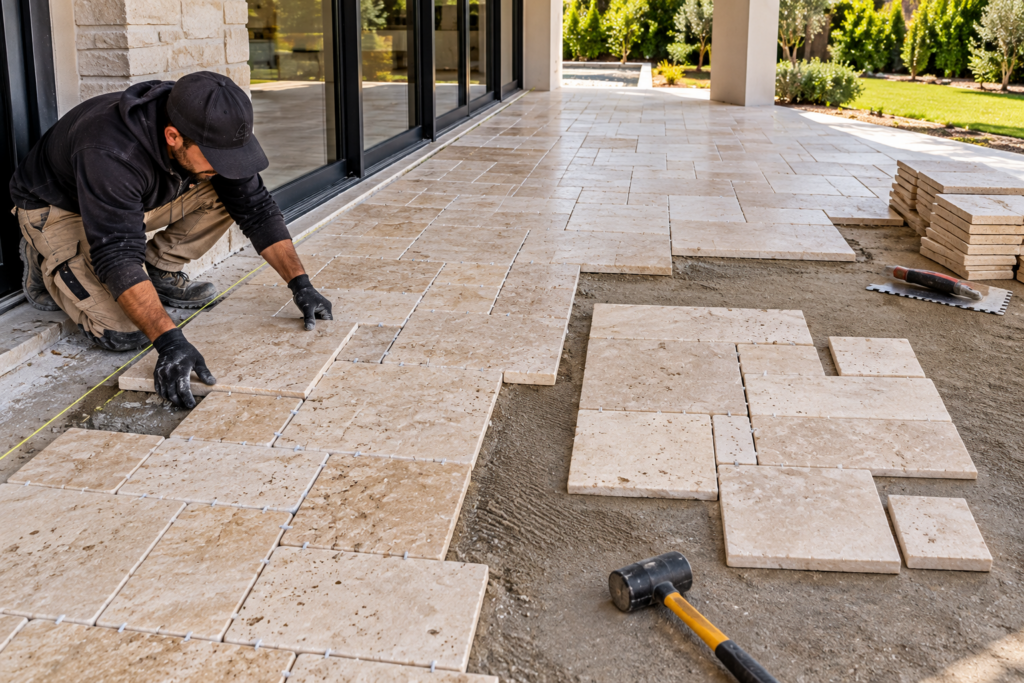
Start from the most visible straight edge, lay the pattern in the same sequence every time, and push all your cuts to the least visible edges. The layout is not difficult once the first couple of square metres are down, but it punishes improvisation.
- Check the base: confirm the slab or sub-base is sound, level to the planned falls and drained away from the house before any stone arrives.
- Pick your starting edge: use the longest, straightest edge that people see most, usually the house wall, a door threshold or the pool coping line.
- Snap a line: set a string line or chalk line parallel to that edge so the first row runs true.
- Dry-lay two sets: lay two full sets loose next to the work area so the installer learns the repeat before any adhesive or mortar goes down.
- Lay in sequence: work outward from the starting edge, placing each set in the same order and orientation, and keep joints even with spacers.
- Mix from several packs: draw pieces from three or four packs at once so natural colour variation spreads evenly instead of landing in patches.
- Cut at the far edges: finish at the fence, garden bed or least visible side, using offcuts from the small pieces where they fit.
- Grout and seal: fill the joints, clean off residue, then seal to the stone and sealer maker’s guidance. Our travertine care and sealing guide covers timing and products.
Keep joint widths consistent across the area and agree the width with your installer before starting, because it changes the repeat slightly. For the joint filler itself, see what to put between pavers.
Common French pattern layout mistakes
Most problems with French pattern come from breaking the sequence rather than from the stone. These are the ones installers see most:
- Rotating pieces to fill a gap: turning a rectangle 90 degrees breaks the repeat and creates a visible straight line.
- Starting in the middle of a rectangle: centring the pattern forces cuts on all four sides, including the edge everyone looks at.
- Mixing module sizes: 600 x 400 and 610 x 406 sets drift apart within a metre or two.
- Ignoring the coping line: if the pool or step edge is not the starting line, you end up with slivers of stone against the coping.
French pattern travertine around pools and edges
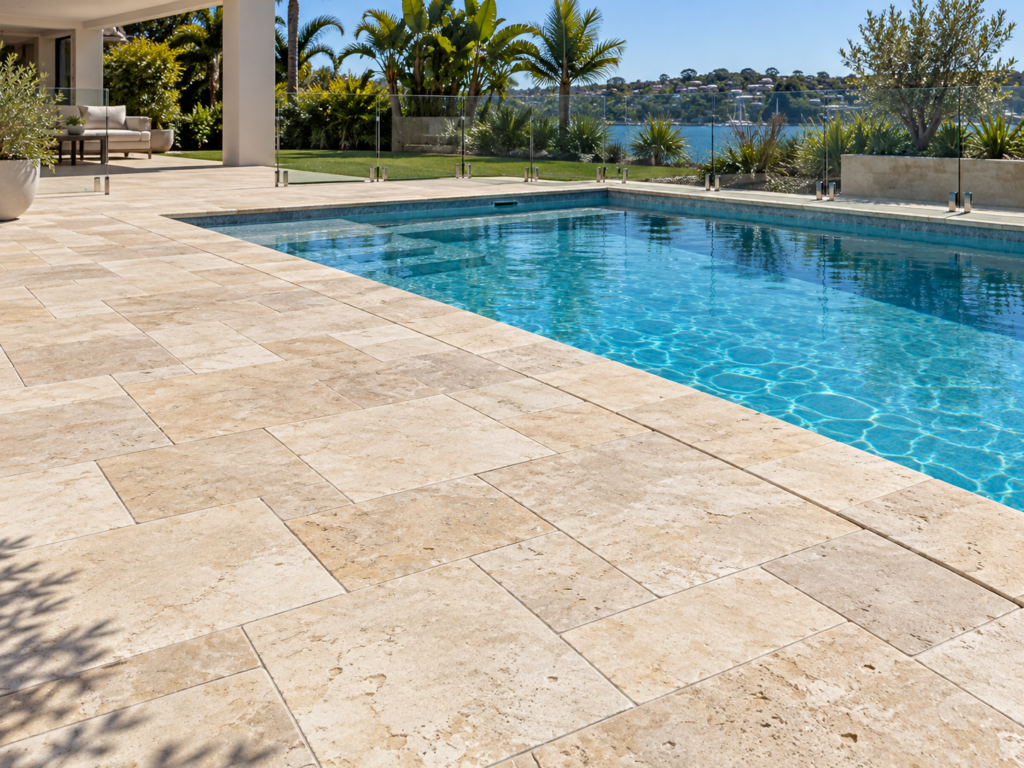
Start the pattern from the back of the coping and run it away from the pool, so every cut lands at the fence or garden edge instead of against the water. The coping forms a straight, continuous border, and the French pattern reads best when it starts cleanly against it.
SIS lists matching coping in the same travertine colours in two profiles: bullnose at 610 x 406 x 30 mm and drop-down at 610 x 406 x 30/60 mm. Because the coping length matches the long edge of the largest French pattern piece, the first row can line up neatly with the coping joints. For help choosing between the two edge styles, see our guide to pool coping profiles.
Around a pool, plan the falls so water runs away from the pool and off the paving, and include expansion joints where your installer or engineer specifies them. If you are still choosing the stone, our comparison of the best stone for pool coping and paving sets travertine against the other common options.
Which travertine colour works best in French pattern?
Lighter travertines keep French pattern soft and bright, while warmer and greyer tones give it more colour movement. All five colours below are listed in French pattern on the SIS product pages. The descriptions come from those pages.
| Colour | Tone | Look in French pattern |
|---|---|---|
| Ivory | Off-white, cream and light beige | Bright and calm, with subtle variation |
| Cashmere | Soft cream with beige and ivory | Calm and warm, with gentle natural variation |
| Classic | Cream, beige and light caramel | The traditional Mediterranean look, with more colour movement |
| Silver | Silver, grey and soft taupe | Cooler and more dramatic, suits minimalist architecture |
| Walnut | Listed in 610 x 406 French pattern with a drop-down edge | Ask for a sample to see the current colour |
Colour varies from batch to batch in any natural stone, so order samples before deciding and order the whole area in one batch. You can order samples of any of these colours, or browse the full natural stone paving range.
Can you use French pattern travertine indoors and outdoors?
Yes, as long as the thickness and finish match the setting. Indoors and in covered areas, 12 mm tiles on a slab give a flat, even floor. Outdoors and around pools, 30 mm pavers with a lightly textured surface are the practical choice, and that is the surface SIS describes on its paving pages.
The other decision is whether the holes in the stone are filled. Filled travertine has the surface holes packed at the factory for a smoother, easier-to-clean floor, which suits indoor rooms. Unfilled travertine keeps its natural pitting, which gives a more rustic texture outdoors. Our guide to filled vs unfilled travertine explains the trade-offs in more detail, and popular paver patterns for Australian homes compares French pattern with stretcher bond, herringbone and grid layouts.
Frequently asked questions about French pattern travertine
1. What is the French pattern in paving?
The French pattern is a layout that uses four stone sizes in a repeating set to create a random look with no continuous joint lines. A standard set has six pieces: one 610 x 406 mm, two 406 x 406 mm, one 406 x 203 mm and two 203 x 203 mm, covering about 0.74 m².
2. How many pieces are in a French pattern travertine set?
A standard French pattern set has six pieces in four sizes. The full visual repeat is two sets, or 12 pieces covering about 1.48 m². Check the piece sizes with your supplier, because some cut the pattern to a 600 x 400 mm module instead of 610 x 406 mm.
3. Is French pattern hard to lay?
French pattern is more demanding than a straight lay but not difficult once the repeat is learned. Dry-laying two sets before starting, working from one straight edge and keeping every set in the same order prevents most problems. Expect more cutting at the edges, which is why you allow 15 percent extra stone.
4. Can you lay French pattern travertine over concrete?
Yes. 12 mm French pattern tiles are glued directly to a sound, flat slab, and 30 mm pavers can be laid on a slab with a mortar or adhesive bed. Check levels at door thresholds and make sure the slab falls away from the house before laying.
5. Does French pattern travertine need sealing?
Sealing is generally recommended for travertine, especially outdoors and around pools, because it reduces staining and makes cleaning easier. Seal once the grout has cured and follow the sealer maker’s instructions, then reapply as the sealer maker recommends.
6. What is the difference between French pattern and Versailles pattern?
In most cases there is no difference: Versailles pattern is the name more common in the United States for the same four-size layout. Some suppliers use either name for slightly different set compositions, so compare piece sizes and quantities rather than relying on the name.
7. Can you get French pattern in limestone or bluestone?
Yes, the French pattern is a layout rather than a material, and some suppliers cut limestone and bluestone into French pattern sets. Availability varies by product and supplier, so ask the SIS team which stones are currently available in French pattern.
Planning a French pattern area? Send us the paved area in m² and any pool or step edges in metres, and we will confirm the number of sets, coping and the best colour for your space. Request a free quote or order samples to see the stone in your own light.


