

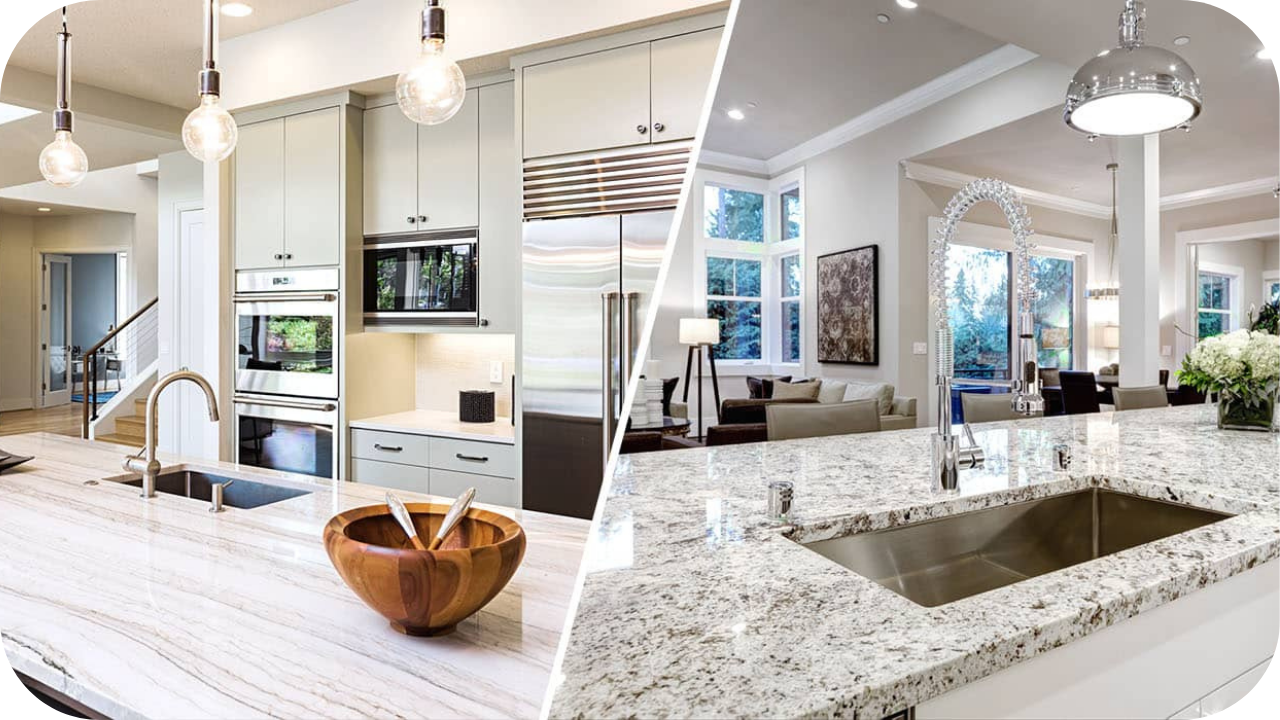
Granite and marble are two of the most recognised natural stones for kitchens. Both can create a premium, timeless finish, but they perform differently in everyday use. If you are choosing a stone for a kitchen benchtop, island, splashback or feature surface, the right option depends on durability, maintenance, staining, heat, design style and long-term value.
Is Granite or Marble Better for a Kitchen?
Granite is usually better for busy kitchens because it is dense, durable and more forgiving with everyday use. Marble is better for kitchens where luxury, softness and natural veining matter more than low maintenance. For family kitchens, rental properties and heavy cooking zones, granite is often the safer practical choice. For statement islands, refined interiors and lower-use kitchens, marble can be worth the extra care.
- Choose granite if: You want durability, lower maintenance and strong everyday performance.
- Choose marble if: You want a soft luxury look and accept more careful cleaning.
- Choose granite for: Busy kitchens, family homes, cooking zones and high-use benchtops.
- Choose marble for: Statement islands, elegant kitchens, baking areas and design-led spaces.
- Best overall for practicality: Granite.
- Best overall for luxury appearance: Marble.
Granite vs Marble at a Glance
| Factor | Granite | Marble | Best Choice |
| Durability | Dense, hard-wearing and practical | Softer and more prone to marks | Granite |
| Stain resistance | More forgiving when sealed | More sensitive to stains and acids | Granite |
| Scratch resistance | More resistant to everyday wear | Can mark more easily | Granite |
| Heat tolerance | Generally strong, but still needs trivets | Heat resistant, but more delicate | Granite |
| Maintenance | Easier to manage | Needs more careful upkeep | Granite |
| Appearance | Natural, mineral-rich and varied | Soft, elegant and heavily veined | Marble |
| Cost | Often practical value | Can vary widely, especially premium slabs | Depends on stone |
| Long-term value | Strong for high-use kitchens | Strong for luxury design impact | Depends on priority |
| Family kitchen suitability | Excellent | Possible, but higher care | Granite |
| Luxury kitchen suitability | Premium and architectural | Classic luxury choice | Marble |
What Is Granite?
Granite is a natural igneous stone formed under intense heat and pressure. It is known for its strength, density and hard-wearing performance, making it a popular choice for kitchen surfaces that need to handle regular use.
Visually, granite often has a speckled, granular or mineral-rich appearance. It is available in light, dark, grey, black, white and mixed tones, giving homeowners a wide range of kitchen stone benchtop ideas to work with. A deeper look at what granite is can help explain why it is often selected for durable, high-use applications.
Because it is so practical, granite is also used across outdoor areas, paving, architectural surfaces and other high-use stone applications.
Best Kitchen Uses for Granite
Granite works especially well for:
- Kitchen benchtops
- Kitchen islands
- Splashbacks
- Butler’s pantry surfaces
- Outdoor kitchen surfaces, where suitable
- High-use food preparation areas
What Is Marble?
Marble is a natural metamorphic stone known for its veining, movement and soft visual character. It has long been associated with classic interiors, luxury kitchens and refined architectural details.
Marble kitchen benchtops can look beautiful, especially in spaces where the stone is intended to be the visual feature. Marble is available in white, grey, cream, green, pink, black and other tones. Compared with granite, it is generally softer and more porous, which means it needs more careful use in busy kitchens.
Over time, marble can develop a patina. Some homeowners love this lived-in character, while others prefer surfaces that stay more uniform. If you are comparing marble for different parts of the home, understanding what marble is can help clarify why it performs differently from denser natural stones.
Best Kitchen Uses for Marble
Marble is well suited to:
- Statement kitchen islands
- Feature splashbacks
- Lower-use benchtops
- Baking zones
- Luxury kitchen details
- Decorative stone surfaces
Granite vs Marble for Durability
For a working kitchen, granite is generally the more durable option. It is harder and denser than marble, which makes it more suitable for areas exposed to daily cooking, cleaning, food preparation and entertaining.
Marble is still a strong natural stone, but it is more prone to scratching, etching and surface marks. That does not mean marble should be avoided. It simply means it needs to be chosen with realistic expectations.
Both stones still require proper care. Neither granite nor marble should be treated as indestructible. Chopping boards, trivets, careful cleaning and professional installation all help protect the surface.
Best Choice for Durability
Granite is usually the better choice for durability in a working kitchen, especially where the surface will be used daily for cooking, cleaning, food preparation and entertaining.
Granite vs Marble for Stains and Etching
Staining happens when liquids absorb into the stone. Etching is different. It occurs when acidic substances react with the stone surface, and this is especially important with marble.
Common kitchen ingredients such as lemon juice, vinegar, wine, coffee and tomato can affect marble if they are left sitting on the surface. Sealing can help reduce staining risk, but it does not make any natural stone invincible. Marble still needs faster clean-up and more careful product selection.
Granite is generally more forgiving, especially when properly sealed. However, it should still be cleaned promptly after spills. For marble-heavy kitchens, avoiding common marble cleaning mistakes is one of the easiest ways to protect the finish.
| Kitchen Risk | Granite | Marble |
| Coffee spills | More forgiving when sealed | Needs quick clean-up |
| Wine spills | More forgiving when sealed | Higher staining and etching risk |
| Lemon juice | Usually more resistant | Can etch |
| Vinegar cleaners | Avoid harsh use | Avoid completely |
| Oil spills | Seal and clean quickly | Seal and clean quickly |
Best Choice for Stain and Etch Resistance
Granite is usually the better choice for stain and etch resistance. Marble can still work beautifully, but it needs more careful use, faster cleaning and the right maintenance routine.
Granite vs Marble for Heat and Daily Cooking
Both granite and marble are natural stones, but granite is usually more forgiving in active cooking areas. It is a practical choice for homeowners who cook frequently, entertain often or need a kitchen surface that can handle daily movement.
That said, hot pans should still be placed on trivets. Direct heat can affect sealers, finishes and the stone surface, especially with sudden temperature changes. A natural stone benchtop is a premium surface, and simple habits can help it last longer.
Best Choice for Busy Cooking Areas
Granite is usually the better choice for busy cooking areas because it offers stronger everyday practicality.
Granite vs Marble for Maintenance
| Maintenance Task | Granite | Marble | Practical Note |
| Daily cleaning | Easy with mild, pH-neutral cleaner | Needs pH-neutral cleaner | Avoid harsh chemicals |
| Spill clean-up | Clean promptly | Clean immediately | Marble is less forgiving |
| Sealing | Often recommended | Usually recommended | Ask your supplier for guidance |
| Avoiding acids | Sensible precaution | Essential | Lemon, vinegar and wine matter |
| Avoiding abrasive cleaners | Recommended | Essential | Abrasives can dull the finish |
| Managing scratches | More resistant | More sensitive | Use chopping boards |
| Managing patina | Less noticeable | Can develop over time | Some homeowners like this effect |
| Long-term upkeep | Lower maintenance | Higher maintenance | Match stone to lifestyle |
For both stones, use pH-neutral cleaning products, blot spills quickly and avoid abrasive pads. Chopping boards and trivets are simple but important. Sealing should be discussed with your supplier, as the right approach depends on the specific stone and finish.
Good stone maintenance matters in kitchens because food, oils, acids, heat and daily cleaning all affect how natural stone looks over time.
Granite vs Marble for Kitchen Design Style
When Granite Looks Best
Granite suits kitchens where natural texture, durability and architectural character matter. It can feel bold, refined or understated depending on the colour and slab selection.
Granite works especially well in:
- Contemporary kitchens
- Dark cabinetry schemes
- Timber kitchens
- Architectural homes
- Outdoor-inspired interiors
- High-contrast kitchens
- Practical family spaces
For homeowners comparing natural stone interiors, granite is a strong option when the kitchen needs both design impact and everyday performance. A broader interior stone design approach can also help connect the benchtop with cabinetry, floors, splashbacks and nearby living spaces.
When Marble Looks Best
Marble suits kitchens where softness, veining and classic luxury are central to the design. It is often chosen when the stone is intended to be the hero of the room.
Marble works especially well in:
- Classic kitchens
- Luxury kitchens
- Soft neutral palettes
- Statement islands
- European-inspired interiors
- Refined splashbacks
- Kitchens where natural veining is the feature
Marble can be particularly effective on a kitchen island, where the veining can be viewed as a design feature rather than only a work surface.
Granite vs Marble Cost: Which Offers Better Value?
The cost of granite and marble depends on the stone type, slab availability, colour, rarity, thickness, finish, fabrication, edge detail, cut-outs, delivery and installation complexity. This is why it is better to compare actual slabs and project requirements rather than relying on a single general price rule.
Costs can vary based on:
- Stone type and origin
- Slab size and availability
- Colour and rarity
- Thickness
- Surface finish
- Edge profile
- Sink, cooktop and tap cut-outs
- Installation complexity
- Delivery requirements
Best Value Choice
Granite often offers better practical value for busy kitchens because it combines durability, natural beauty and lower maintenance. Marble can offer strong design value when visual impact is the main priority.
Should You Use Granite or Marble for a Kitchen Island?
Kitchen islands are both functional and visual. They are often used for food preparation, serving, entertaining, homework, casual meals and gathering. This makes the choice between granite and marble especially important.
Granite is usually better for working islands because it is more durable and easier to live with. Marble is better for statement islands where the stone is chosen mainly for its veining, softness and luxury appearance.
Before choosing, think about how often the island will be used for food preparation, whether children will use the surface, and whether it will be exposed to coffee, wine, lemon, tomato or oil.
Best Choice for Kitchen Islands
- Working island: Granite.
- Statement island: Marble.
- Family island: Granite.
- Luxury display island: Marble.
- Low-maintenance island: Granite.
Should You Use Granite or Marble for a Kitchen Splashback?
Both granite and marble can work as kitchen splashbacks. Marble is often chosen for feature splashbacks because its veining can create a strong visual statement behind a cooktop, sink or open shelving area.
Granite can be a more practical splashback option where durability and easier care matter more. It can also create a cohesive look when matched with a granite benchtop or island.
For slab splashbacks, professional measurement and installation are essential. Areas near cooktops also need careful product selection and advice from your supplier or installer.
Best Choice for Splashbacks
Marble is often chosen for statement splashbacks, while granite is a practical option where durability and easier care matter more.
Granite vs Marble vs Quartzite: Should You Consider Another Natural Stone?
If you like the veining of marble but want stronger everyday practicality, quartzite may be worth considering. It is another natural stone option that can offer dramatic movement with strong performance, depending on the specific stone selected.
| Stone | Best For | Strengths | Considerations |
| Granite | Busy kitchens and high-use benchtops | Durable, practical and versatile | Appearance can be more granular |
| Marble | Luxury kitchens and statement features | Elegant veining and soft movement | Needs more care around stains and acids |
| Quartzite | Homeowners wanting veining with practicality | Strong natural stone with striking patterns | Needs correct selection and sealing advice |
When comparing these options, a detailed look at quartzite vs marble can help if you want natural veining but are unsure whether marble suits your maintenance expectations.
If you are also comparing natural and man-made materials, natural stone vs engineered stone should be considered before making a final decision.
Which Stone Is Best for Different Kitchen Types?
| Kitchen Type | Best Stone | Why |
| Busy family kitchen | Granite | Durable, practical and easier to maintain |
| Luxury display kitchen | Marble | Strong visual impact and refined veining |
| Entertainer’s kitchen | Granite | More forgiving with spills and frequent use |
| Minimalist kitchen | Granite or marble | Depends on colour, finish and design intent |
| Traditional kitchen | Marble or granite | Both can suit classic interiors |
| Apartment kitchen | Granite | Practical for compact, high-use spaces |
| Rental or investment property | Granite | Better everyday resilience |
| Outdoor kitchen | Granite or other suitable stone | Suitability depends on the stone and location |
| Baking-focused kitchen | Marble | Useful for baking zones, but needs care |
| High-end renovation | Marble or granite | Choose based on lifestyle and design priority |
For soft, restrained kitchens, a guide to minimalist stone interiors can help you compare stone colours, movement and finishes.
Common Mistakes When Choosing Between Granite and Marble
- Choosing only by appearance: A beautiful stone still needs to suit daily use.
- Ignoring maintenance: Marble needs more care than granite.
- Assuming sealing prevents all damage: Sealing helps, but it does not stop every stain, mark or etch.
- Using acidic cleaners on marble: Vinegar and citrus-based cleaners can damage marble.
- Forgetting how the kitchen is used daily: A family kitchen has different needs from a display kitchen.
- Choosing a polished finish without thinking about marks: Finishes affect how wear appears.
- Not viewing slabs or samples in real light: Natural stone changes under different lighting.
- Not asking about fabrication and installation: Cut-outs, joins and edges affect the final result.
- Treating all kitchen surfaces the same: Islands, benchtops and splashbacks have different demands.
- Choosing marble but expecting granite-level practicality: Marble is beautiful, but it needs care.
- Choosing granite without checking slab variation: Granite can still vary significantly from slab to slab.
Many of these issues overlap with wider natural stone selection mistakes, especially choosing by appearance alone and ignoring how the surface will be used.
How to Choose Between Granite and Marble
Start with how you use the kitchen. Daily cooking, entertaining and family use usually need a more forgiving surface.
- Decide how much maintenance you will accept: Marble needs more care, especially around acids and spills.
- Choose the right stone for each surface: Islands, splashbacks and benchtops have different requirements.
- Compare samples in your own light: Natural stone can look different in morning light, evening light and artificial light.
- Think about stains and acids: Wine, lemon, vinegar, tomato and coffee should influence your decision.
- Ask about sealing: Sealing supports protection, but it does not remove all risk.
- Check the finish: Honed, polished and textured finishes behave differently.
- Confirm fabrication needs: Cut-outs, joins and edge details affect cost and installation.
- Ask for supplier guidance: Stone choice should match the project, not just the mood board.
- Choose for long-term living: The best stone is the one that suits your home, habits and expectations.
Final Verdict: Granite or Marble for Your Kitchen?
Granite is the better choice for most busy kitchens because it is durable, practical and easier to live with. Marble is the better choice for homeowners who want a softer, more luxurious surface and are comfortable with extra care. If the kitchen is used heavily every day, choose granite. If the kitchen is design-led and you accept patina, marble can be beautiful.
- Best for practicality: Granite.
- Best for luxury: Marble.
- Best for families: Granite.
- Best for statement islands: Marble.
- Best for lower maintenance: Granite.
- Best for classic elegance: Marble.
Choosing Natural Stone for Your Kitchen With Splendour In Stone
Choosing between granite and marble is easier when you can compare real stone, finishes and samples against your design plans. Splendour In Stone can help homeowners, designers, builders and architects assess natural stone options for interior projects, including granite, marble and quartzite.
If you are comparing granite and marble for a kitchen benchtop, island or splashback, Splendour In Stone can help you choose a natural stone that suits your design style, maintenance expectations and project requirements.
FAQs
1. Is granite or marble better for kitchen benchtops?
Granite is usually better for busy kitchen benchtops because it is more durable and easier to maintain. Marble is better for luxury kitchens where appearance matters more than low maintenance.
2. Does marble stain more than granite?
Marble is generally more prone to staining and etching than granite, especially when exposed to acidic liquids such as lemon juice, vinegar, wine and tomato.
3. Is granite cheaper than marble?
Granite is often more cost-effective than many premium marbles, but pricing depends on the stone type, slab, finish, thickness, fabrication and installation.
4. Is marble good for kitchen islands?
Marble can be excellent for statement kitchen islands, but it needs careful use and regular maintenance. Granite is usually better for high-use family islands.
5. Can you put hot pans on granite or marble?
Use trivets on both granite and marble. Natural stone can handle heat better than many materials, but direct heat can still affect sealers, finishes or the stone surface.
6. Does granite need sealing?
Many granite surfaces benefit from sealing, especially in kitchens. Ask your supplier for advice based on the specific stone and finish.
7. Does marble need sealing?
Marble usually benefits from sealing because it is more porous and more sensitive to stains. Sealing helps, but it does not prevent etching from acidic substances.
8. What is easier to clean, granite or marble?
Granite is usually easier to clean and more forgiving. Marble needs pH-neutral cleaners, fast spill clean-up and more care around acidic foods and drinks.
9. Which stone looks more luxurious?
Marble is often seen as the more luxurious stone because of its soft veining and classic appearance. Granite can also look premium, especially in darker, dramatic or architectural kitchens.
10. What is the best natural stone for a busy kitchen?
Granite is one of the best natural stones for a busy kitchen because it offers durability, practicality and strong design versatility.



