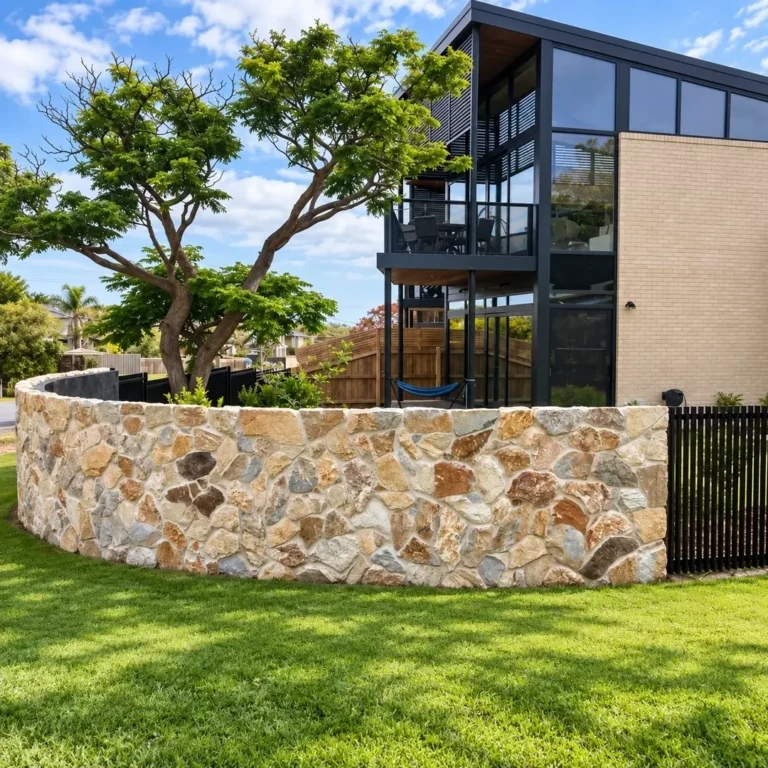
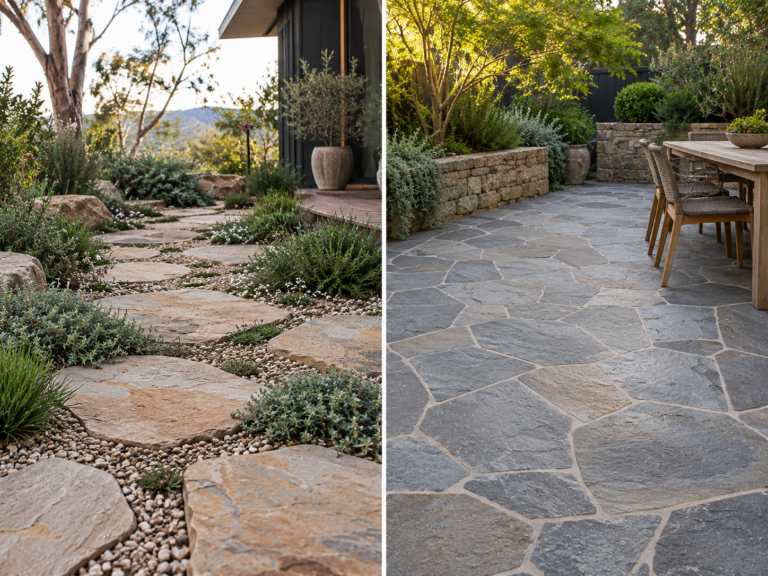
Pool coping is the capping course that finishes the top edge of a pool shell, protects the structure and creates the transition to the surrounding paving. The right choice depends on three connected decisions: the coping profile, the stone and surface finish, and how the edge will be installed.
Porphyry can bring rich colour and texture into the pool landscape, but it should not be assumed to be available in every coping profile. Confirm the required dimensions, edge treatment and fabrication before designing the complete pool surround around it.
What Does Pool Coping Do?
Pool coping finishes the exposed top of the pool shell and creates a stable edge between the water and the surrounding surface. Most concrete or masonry pools need a properly designed coping detail, even when the wider surround uses timber, lawn or a different paving material.
Pool coping performs several practical roles:
- Protects the pool edge: It covers the top of the shell or bond beam and limits direct exposure to water, weather and regular use.
- Creates a finished handhold: The edge becomes the point swimmers grip when entering or leaving the water.
- Connects the pool to the landscape: It forms the transition between the waterline, shell and surrounding paving.
- Supports water management: The finished levels and falls help move splash-out towards the drainage system.
- Frames the pool visually: The profile, colour and width influence whether the edge appears soft, traditional, sharp or architectural.
- Conceals construction details: It covers the junction between the pool structure, waterline tiles and adjacent paving.
Without a correctly designed edge, the top of the pool can look unfinished and may be more exposed to moisture, movement and damage. The coping should therefore be selected early enough for the pool builder, landscaper and stone supplier to coordinate levels and dimensions.
Pool Coping Profiles Compared

The coping profile describes the shape of the edge that faces the water. It affects the appearance of the pool, how the edge feels when held or sat on, and the amount of fabrication required.
| Coping profile | Description | Visual effect | Where it may suit | Practical points |
| Bullnose | A rounded front edge | Soft and established | Family pools, curved pools and traditional landscapes | Comfortable to grip, but the radius and available sizes must be confirmed |
| Drop edge or drop face | A vertical face extends over the pool wall | Thick and architectural | Contemporary pools with straight lines | Requires careful measurement and corner fabrication |
| Square edge | A straight edge with little or no rounding | Clean and minimal | Modern pools and restrained designs | Edge comfort and finish must be reviewed |
| Rebated edge | The underside is cut to fit over part of the pool structure | Substantial without using a fully solid thick piece | Projects requiring a concealed structural junction | Must match the pool-shell detail precisely |
| Chamfered or arris edge | A small bevel softens the sharp corner | Crisp but less severe than a square edge | Contemporary designs requiring a subtle edge treatment | Bevel dimensions should remain consistent around the pool |
Bullnose Coping
Bullnose coping has a rounded outer edge that softens the transition into the pool. It is often chosen where swimmers are likely to grip, sit on or move across the edge regularly.
The radius can vary between suppliers and products. A small pencil-round edge will look different from a full bullnose, so the project documents should show the intended profile rather than simply state “rounded coping”.
Current SIS ranges confirm bullnose coping in several bluestone and travertine formats. For example, Sawn Bluestone includes bullnose units in 600 × 300 × 30 mm, 800 × 400 × 30 mm and 1000 × 500 × 30 mm sizes.
Drop Edge Coping
Drop edge coping has a vertical face that extends down over the waterline side of the pool. This creates the visual impression of a thick stone slab and conceals more of the pool-shell junction.
It works particularly well with straight pool lines, large-format paving and contemporary architecture. Corners, curves, steps and spas require accurate fabrication because inconsistent face depths become highly visible beside the water.
The verified Honed Bluestone range includes several drop-down formats, such as 600 × 350 × 20/40 mm and 800 × 400 × 20/50 mm. The notation and exact face detail should be confirmed on the shop drawing before ordering.
Square Edge Coping
Square edge coping creates a simple, straight line around the water. It can suit minimalist pools where the paving and coping are intended to appear as one continuous plane.
A visually sharp edge may not feel the same as a rounded one when swimmers hold or sit on it. The chosen piece should be viewed and handled as a physical sample before the profile is approved.
Rebated Coping
A rebated coping unit is cut on the underside to fit over the pool structure or another construction element. The profile can create a thicker visual edge while controlling the amount of stone used.
Because the rebate must align with the shell and waterline detail, it normally requires project-specific measurements. It should not be ordered from a broad pool dimension alone.
Chamfered Coping
Chamfering removes the sharpest part of a square corner while retaining a clean architectural appearance. It can provide a practical middle ground between a full bullnose and a completely square edge.
The amount removed should be nominated clearly so the fabricator produces a consistent edge around straight runs and corners.
What Thickness and Overhang Should Pool Coping Have?
Pool coping thickness and overhang should be set according to the selected profile, pool-shell construction, waterline tiles and surrounding paving. There is no universal dimension that works for every pool.
Instead of starting with an arbitrary overhang, confirm the complete edge detail with the pool builder.
| Element | What to confirm | Why it matters |
| Coping width | Distance from the water-facing edge to the outside joint | Must cover the shell while connecting cleanly to the paving |
| Stone thickness | Available product thickness and structural support | Affects finished level, weight and fabrication |
| Water-side projection | Amount the coping extends beyond the shell or tile face | Changes the shadow line, grip and water movement |
| Drop-face depth | Vertical dimension of the front face | Must conceal the intended section of the pool edge |
| Joint width | Space between individual coping units | Allows consistent set-out and compatible jointing |
| Fall | Direction and gradient of the finished surface | Helps control splash-out and surface water |
| Bedding depth | Space required for adhesive, mortar or bedding | Affects final level and bond |
| Movement joint | Separation between the pool structure and adjoining paving | Allows different structural sections to move appropriately |
Stocked coping dimensions can help establish what is practical. The Silver Travertine range includes a 610 × 406 × 30 mm bullnose and a 610 × 406 × 30/60 mm drop-down format.
However, product availability does not determine the required overhang. The pool builder should provide the shell and waterline detail, while the stone supplier or fabricator confirms whether the selected profile can be produced in the required size.
Which Stone Works Best for Pool Coping?

The best stone for pool coping is the one that suits the design, tested surface requirements, pool chemistry, expected maintenance and available edge profile. No stone type is automatically suitable in every finish.
| Stone | Poolside character | Main consideration | Coping availability |
| Porphyry | Earthy red, plum, bronze and grey variation | Confirm custom edge fabrication and finish | Not currently verified as a standard SIS coping profile |
| Bluestone | Blue-grey to charcoal and architectural | Darker tones can warm in direct sun | Bullnose and drop-edge options verified |
| Travertine | Cream, beige, silver and softly varied | Voids, sealing and pool-water exposure | Bullnose and drop-edge options verified |
| Limestone | Refined cream, beige or grey tones | Acid sensitivity, absorption and sealing | Depends on the specific SIS product |
| Granite | Dense appearance with grey or charcoal tones | Finish-specific wet performance | Confirm product and fabrication |
| Sandstone | Warm natural colours and visible texture | Absorption, salt exposure and maintenance | Confirm product and fabrication |
A more detailed comparison of stone for pool coping and paving can help narrow the material before the edge profile is selected.
Can Porphyry Be Used for Pool Coping?
Porphyry can be incorporated into pool landscapes, but the coping format must be verified before it is specified. The current SIS product pages list porphyry as cobbled paving and narrow Filetti Porphyry, rather than as a stocked bullnose or drop-edge coping unit.
This creates three realistic design options:
- Use porphyry across the surrounding paving and select a compatible stone for the pool edge.
- Ask whether custom porphyry coping can be fabricated in the required profile.
- Use a square or minimally worked porphyry edge only after the fabricator and pool builder confirm its dimensions, finish and support.
Porphyry should not be shown in project documentation as a standard coping product unless its availability has been confirmed in writing.
Bluestone
Bluestone suits pools with grey paving, dark window frames, concrete and contemporary architecture. Sawn and honed products are available in bullnose and drop-edge formats, but the exact surface finish must be checked for wet-area use.
Travertine
Travertine offers cream, beige and silver tones that suit warmer, resort-style pool areas. Current SIS ranges include both bullnose and drop-down profiles, making it easier to coordinate the coping with the surrounding pavers.
Its natural voids and calcium-based composition require careful product selection, sealing and maintenance around pool water.
Limestone
Limestone can create a restrained, light-toned pool edge. The selected product should be assessed for absorption, surface finish and chemical exposure.
The considerations involved in using limestone around a swimming pool are particularly important where salt, chlorine or acidic cleaning products may contact the surface.
How Slip Resistance Works Around a Pool
A pool surround needs a surface classification appropriate to a regularly wet, barefoot environment. The rating must relate to the exact stone finish being supplied, not simply to porphyry, bluestone, limestone or travertine as a material.
AS 4586 classifies new pedestrian surface materials using several test methods. Wet barefoot testing is assessed differently from ordinary shod pedestrian movement, while the applicable project requirements must be confirmed by the designer, builder or relevant consultant. The NCC also references AS 4586 for specified pedestrian surfaces.
Before approving coping or surrounding paving:
- Request test data for the exact stone and finish.
- Confirm whether the report covers the relevant wet barefoot test.
- Check the test sample matches the supplied finish.
- Consider how sealing could change the surface.
- Account for sunscreen, leaves, algae and other contaminants.
- Provide suitable drainage and regular cleaning.
- Reassess the surface if wear changes its texture over time.
Avoid claims such as “non-slip”, “slip-proof” or “safe underfoot”. A more accurate requirement is a classification appropriate to the wet barefoot application, supported by test data for the specific supplied finish.
How Pool Chemistry Affects Stone Coping

Pool coping is repeatedly exposed to splash-out, evaporation, cleaning products, salt or chlorine and periods of intense sun. The effect depends on the stone composition, porosity, finish, sealer and water balance.
- Chlorinated water: Repeated wetting and drying can leave deposits on the surface and in joints.
- Saltwater systems: Salt can remain after water evaporates and may crystallise within porous stone or bedding materials.
- Calcareous stone: Limestone and travertine contain calcium carbonate and are sensitive to acidic products.
- Unbalanced water: Water chemistry outside the recommended operating range may affect grout, sealers and some stone finishes.
- Acid washing: Acid can etch calcareous stone and should not be used as a universal cleaning method.
- Metal contamination: Furniture, fixings or tools can leave rust-coloured marks when moisture is present.
- Sealers: An impregnating product may improve stain resistance, but it does not make the stone waterproof or maintenance-free.
The Natural Stone Institute recommends identifying whether a stone is calcareous or siliceous before choosing cleaning products. It also advises using mild, non-acidic products on calcium-carbonate stones and notes that impregnating sealers improve stain resistance rather than making stone stain-proof.
A practical maintenance plan should include prompt rinsing of concentrated splash marks, pH-neutral cleaning, regular inspection of joints and resealing according to the product manufacturer’s instructions.
Joining Coping to the Surrounding Paving
The coping-to-paving junction is one of the most visible parts of the finished pool. It must coordinate colour and pattern while allowing for drainage and movement.
Confirm the following before installation:
- Whether coping and paving will match or intentionally contrast
- How paving joints align with coping joints
- Finished levels at the waterline, coping and wider surround
- Falls away from the pool where required
- Drain locations and grate widths
- Movement joints between structural sections
- Corner and curved-edge fabrication
- Step, spa and water-feature junctions
- Sealer compatibility across different stone types
- Replacement access if an individual unit is damaged
Matching coping and paving can create a continuous surface. A contrasting edge can frame the water more clearly, but the difference should feel deliberate.
Porphyry may be particularly effective as a contrasting surround. Its smaller units and varied colours can sit beside a simpler bluestone, limestone or travertine coping profile without requiring the porphyry itself to form the pool edge.
Can You Replace Pool Coping Yourself?

Pool coping replacement is generally better handled by an experienced pool or stone installer. The work involves more than lifting one paver and applying new adhesive.
Removing old coping may expose:
- A damaged or uneven bond beam
- Failed bedding or waterproofing
- Loose waterline tiles
- Cracked joints
- Incorrect drainage falls
- Movement between the shell and surrounding paving
- Corroded metal fittings
- Unstable adjoining pavers
An installer should identify why the coping failed before fitting the replacement. Rebonding a loose piece without repairing the underlying cause may only provide a temporary result.
When requesting a replacement quote, provide:
- Pool perimeter or affected length
- Existing stone and profile
- Coping width and thickness
- Photographs of cracks, movement and hollow sections
- Details of the waterline tiles
- Pool shape, corners, steps and curves
- Surrounding paving that will remain
- Site access
- Preferred replacement stone and profile
The guide to replacing damaged pool coping explains how the existing shell edge, waterline and paving should be assessed together before new units are installed.
Frequently Asked Questions
1. What is pool coping?
Pool coping is the capping material installed along the top edge of a swimming pool shell. It protects the edge and creates the transition between the water and surrounding surface.
2. Do you need coping around a pool?
Most concrete and masonry pools need a properly designed edge treatment. Coping protects the exposed shell and provides a finished junction with paving, decking or landscaping.
3. What is the difference between bullnose and drop-edge coping?
Bullnose coping has a rounded water-facing edge, while drop-edge coping has a vertical face that extends down over the pool wall. Bullnose feels softer, while drop-edge coping creates a thicker architectural appearance.
4. How much should pool coping overhang?
The overhang should be set by the pool-shell, waterline and coping profile details. Ask the pool builder to document the required projection instead of relying on a universal measurement.
5. What is the best stone for pool coping?
There is no single best stone for every pool. The right material depends on the available profile, tested surface finish, sun exposure, pool chemistry, colour and maintenance expectations.
6. Can porphyry be used for pool coping?
Porphyry may be considered where the required coping profile can be fabricated and supported correctly. Current SIS pages verify porphyry paving and cobble formats but do not confirm a stocked bullnose or drop-edge coping product.
7. Does pool coping need sealing?
Some natural stone coping may benefit from an appropriate impregnating sealer, but the requirement varies by stone and finish. Confirm the sealer with the stone supplier and follow the manufacturer’s application and maintenance instructions.
8. Can pool coping be replaced without damaging the pool shell?
It may be possible, but removal must be handled carefully because coping connects with the bond beam, bedding and waterline tiles. An experienced installer should assess the existing construction before replacement begins.
Pool coping should be selected as part of the entire pool-edge system, not as a decorative strip added after the shell and paving are designed. Confirm the profile, dimensions, tested finish, pool chemistry and connection to the surrounding paving before placing the order.
Compare colours and textures across the natural stone paving collection, then request stone samples to assess them beside the pool finish, exterior materials and landscaping. Project drawings, measurements and photographs can also be sent through when you are ready to discuss pool coping options.