The quickest answer on how to cut pavers is that an angle grinder with a diamond blade handles most jobs, a wet saw gives the cleanest edge on hard or visible cuts, a guillotine is fastest for repeated straight cuts in suitable material, and a hammer and chisel suits rustic edges where a rough break is the look you want. The right choice depends more on the material than on the tool you happen to own.
That last point is where most guides stop short. A concrete paver, a clay brick paver and a natural stone paver behave differently under a blade, and a method that works cleanly on one will chip, shatter or burn another.
Which cutting method should you use?

Pick the method by three things: how many cuts you have, whether the cut edge will be visible, and how hard and how brittle the material is. One or two hidden cuts do not justify hiring a saw. Twenty visible cuts through a hard stone do.
|
Method |
Cut quality |
Speed |
Skill needed |
Best for |
|---|---|---|---|---|
|
Angle grinder |
Good with care |
Moderate |
Moderate |
Most jobs, curves, on-site trimming |
|
Wet saw |
Excellent |
Moderate |
Low to moderate |
Visible cuts, hard and brittle stone |
|
Masonry saw (demo saw) |
Good |
Fast |
Moderate |
Large volumes, thick units |
|
Circular saw with masonry blade |
Fair to good |
Moderate |
Moderate |
Occasional cuts with a tool you own |
|
Tile saw |
Excellent on thin units |
Slow |
Low |
Thin pavers and small formats |
|
Guillotine cutter |
Rough, split edge |
Very fast |
Low |
Repeated straight cuts, no power needed |
|
Splitter |
Rough, split edge |
Fast |
Low |
Cobbles and small units |
|
Hammer and chisel |
Rough, hand-split |
Slow |
Moderate |
Rustic edges, one-off cuts, no power |
A wet cut is almost always the better cut. Water cools the blade, keeps the edge from burning, extends blade life and suppresses the dust, which matters more than most people realise when the material is stone.
The eight methods

1. Angle grinder
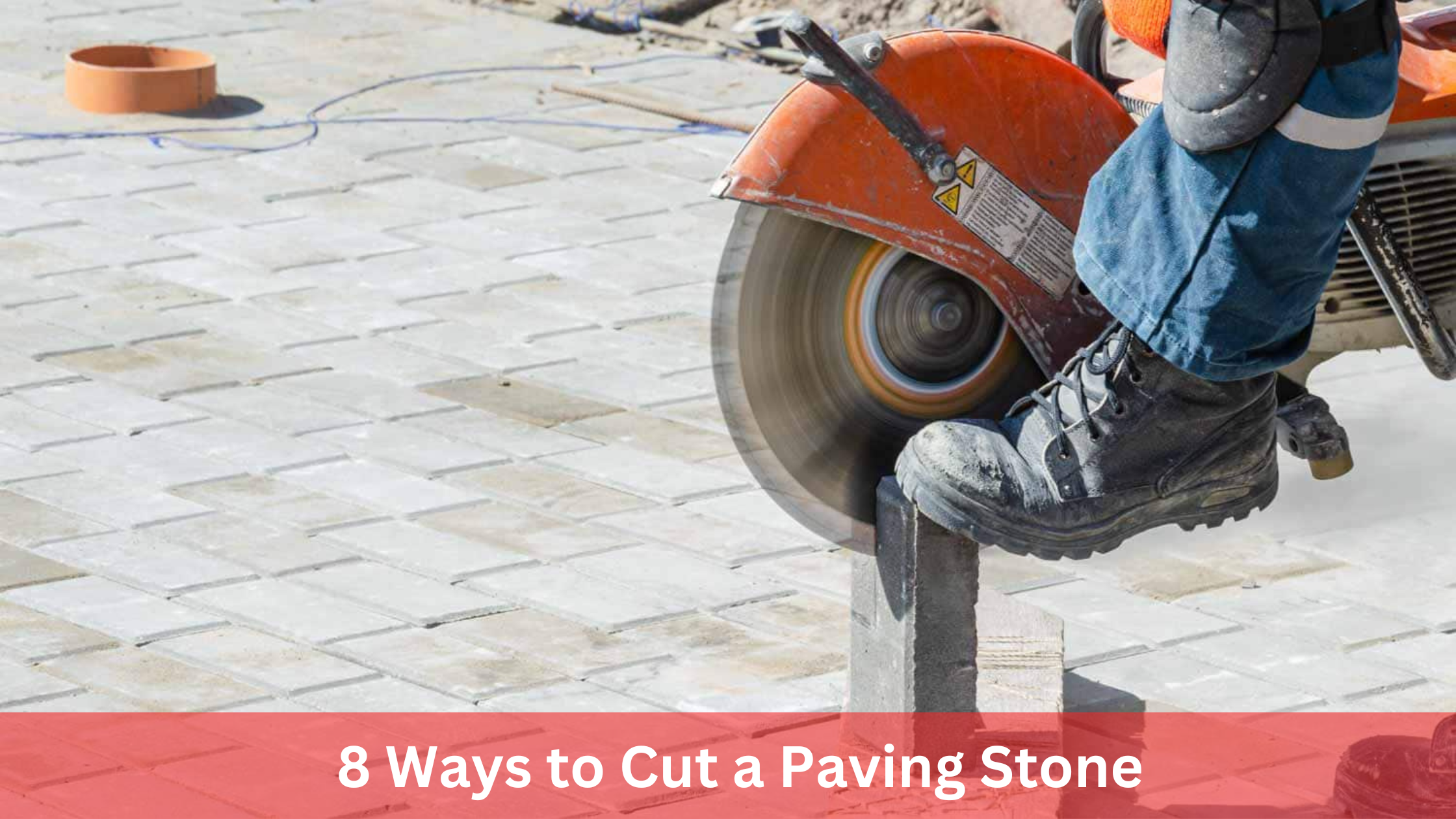
An angle grinder is a handheld tool spun at high speed with a diamond blade fitted, and it is the most common way pavers get cut on site. It handles straight cuts, curves and notches, and it goes to the paver rather than the paver going to it. Score the line first at shallow depth, then deepen it in passes rather than forcing a single cut.
Its weakness is control. A 115mm or 125mm grinder will not cut through a thick paver in one pass, so you cut both faces and snap, which leaves a small ridge to dress back.
Best for: most jobs, curved cuts, notches around drains and posts, and trimming in place.
2. Wet saw
A wet saw is a bench-mounted saw with a diamond blade running through a water bath or fed by a pump. It gives the cleanest edge of any method and it is the safest way to cut hard or brittle material, because the water stops the blade heating and stops the stone shocking.
It is slower to set up than a grinder and it is not portable in any real sense, so it suits a cutting station rather than trimming in position.
Best for: visible cut edges, hard stone, and any cut where the finished face will be on show.
3. Masonry saw
A masonry saw, often called a demo saw or cut-off saw, is a petrol-driven saw with a large diamond blade. It cuts fast, cuts deep and gets through thick units in a single pass, which is why it turns up on commercial sites.
Fit it with a water attachment. Running one dry through stone throws a large volume of dust and shortens the blade badly.
Best for: high volumes, thick pavers and full-depth cuts.
4. Circular saw with a masonry blade
A standard circular saw fitted with a diamond or masonry blade will cut pavers, and for someone who already owns the saw it avoids a hire fee. Depth is the limit: most circular saws will not reach through a full-thickness paver, so you cut from both faces and meet in the middle.
Check the saw is rated for the blade before fitting one, and do not use a timber blade under any circumstances. Depth becomes the deciding factor on thicker material, which is one reason laying granite pavers usually calls for a proper saw rather than whatever is in the shed.
Best for: occasional cuts where you already own the tool and the cut edge will be hidden.
5. Tile saw
A tile saw is a small wet saw designed for tiles, and it will handle thin pavers and small formats accurately. On thicker units it runs out of depth and the motor labours.
Where it earns its place is precision. If you are fitting small pieces into a pattern or cutting a mitred corner, a tile saw gives more control than a grinder will.
Best for: thin pavers, small units and detailed pattern work.
6. Guillotine cutter
A guillotine cutter is a manual lever press with two blades that scores and splits a unit rather than sawing through it. It needs no power, makes no dust and cuts fast, which makes it efficient for repeated straight cuts along an edge.
The edge it leaves is a split face rather than a sawn one. That reads well in some settings and looks wrong in others, and the split does not always follow the line exactly. Guillotines are designed around concrete and clay pavers. Whether one suits any given natural stone depends on the stone, so confirm before using one on a material you have not split before.
Best for: repeated straight cuts in suitable material, and sites with no power.
7. Splitter
A splitter, hydraulic or manual, works on the same principle as a guillotine but with more force, and it suits cobbles and small dense units that a guillotine struggles with. It is a production tool: fast once set up, not worth it for a handful of cuts.
The split face it produces is the point rather than a compromise. On cobblestone work, a split face matches the material’s own texture better than a sawn edge does, which is worth knowing before you reach for a saw. That texture is part of why cobblestones laid on mesh read the way they do.
Best for: cobbles, setts and small dense units where a split face is wanted.
8. Hammer and chisel
A bolster chisel and a club hammer will cut a paver by scoring a line on all faces and then striking along it until the unit breaks. It is slow, it takes practice and the break is not precise.
It is also the only method that costs nothing, needs no power and produces no dust, and it gives a hand-split edge that suits informal and heritage work. For one or two cuts in a soft or naturally bedded stone, it is often the sensible choice.
Best for: rustic edges, single cuts, sandstone and other bedded stone, and jobs with no power on site.
Matching the cutting method to your paver material
Material is the variable that decides most of this. Dense, even-grained stone takes a saw well. Softer and more porous stone chips at the arris if the blade is not cooled. Bedded stone splits cleanly along its natural planes and fights you across them.
|
Material |
Recommended method |
Approach with care |
Edge notes |
|---|---|---|---|
|
Concrete paver |
Guillotine, angle grinder, masonry saw |
Dry cutting, which loads the blade |
Splits and saws predictably |
|
Clay brick paver |
Guillotine, angle grinder, wet saw |
Dry cutting |
Splits cleanly along the length |
|
Bluestone |
Wet saw, angle grinder with diamond blade |
Splitting tools on thin units |
Dense and even, takes a clean sawn edge |
|
Travertine |
Wet saw, tile saw |
Dry cutting and heavy-handed grinding |
Softer and porous, prone to chipping at the edge |
|
Limestone |
Wet saw, angle grinder |
Dry cutting |
Fine grained, cuts cleanly when cooled |
|
Sandstone |
Hammer and chisel, wet saw |
Cutting across the bedding plane |
Splits naturally along the bed, rustic edge suits it |
|
Granite |
Wet saw, masonry saw with a diamond blade |
Anything without diamond tooling |
Very hard, needs a proper blade and patience |
|
Porphyry |
Splitter, wet saw |
Guillotine on irregular units |
Naturally irregular, a split face matches the material |
This table is trade guidance on material behaviour, not a specification for any particular product. Check the recommendation for the exact stone you have before cutting into a pallet of it.
Cutting stone safely: dust, PPE and wet cutting
Cutting stone dry generates respirable crystalline silica, and that is a health risk taken seriously in Australian workplaces. Safe Work Australia publishes the duties and control measures that apply, and they are worth reading before a job rather than after it.
- Cut wet wherever the tool allows it. Water suppresses dust at the source, which is the most effective control available on a domestic site.
- Work outdoors and upwind. Never cut stone in an enclosed space such as a garage or a covered alfresco area.
- Wear respiratory protection rated for fine dust. A nuisance dust mask is not adequate for silica. Check the classification against AS/NZS 1716.
- Wear eye and hearing protection. Diamond blades throw fragments and cut-off saws are loud enough to damage hearing on a single job.
- Wear gloves and long sleeves, and keep loose clothing away from the blade.
- Clean up wet, not dry. Hose slurry away rather than sweeping dried dust back into the air.
- Support the paver fully. Most blade grabs happen because the offcut drops and pinches the blade before the cut is finished.
Should you hire a saw or cut by hand?
Hire once you pass roughly a dozen cuts, or as soon as the cut edges are going to be visible. Below that, a grinder or a chisel is usually the better use of a day.
The variables worth pricing before you decide are the number and type of cuts, whether you need a wet setup, blade wear if you are buying rather than hiring, and how much your own time is worth against a paying installer’s. On a large or patterned area the calculation often falls the other way entirely, because cutting is where a job either looks professional or does not.
One thing worth doing before any of it: set the layout out dry and mark every cut. Most jobs need fewer cuts than people assume, and a good layout can move a full course rather than cutting one.
Common mistakes when cutting pavers

Cutting dry when the tool takes water is the most common and the most consequential, because it costs you blade life, edge quality and air quality in one go. Close behind is forcing the cut: a diamond blade removes material at its own rate, and pushing harder heats the blade and burns the stone rather than speeding anything up.
The other four turn up repeatedly. Skipping the score line means the blade wanders on the first pass. Cutting an unsupported paver lets the offcut drop and pinch. Cutting from the wrong face pushes the chipping onto the visible side rather than the hidden one, so mark and cut with the good face up on a saw and face down on a grinder finishing cut. And cutting to the exact measurement, rather than leaving a joint allowance, leaves you a piece that will not sit. Work out your joint width before you cut, because what goes between the pavers sets the gap you are cutting to.
Frequently asked questions
1. What is the best tool to cut pavers?
An angle grinder with a diamond blade is the best all-round tool, because it handles straight cuts, curves and notches and it works in position. A wet saw beats it on cut quality and is the better choice where the edge will be visible or the stone is hard and brittle. For volume, a masonry saw is faster than both.
2. Can you cut pavers without a saw?
Yes. A guillotine cutter splits pavers with a lever press and needs no power at all, and a bolster chisel and club hammer will break a paver along a scored line. Both leave a split rather than a sawn edge, which suits rustic and heritage work but looks wrong against a sawn finish.
3. What blade do you use to cut pavers?
Use a diamond blade rated for the material and the tool. Blades are made differently for concrete, for hard natural stone and for general masonry, and a blade matched to the material cuts faster and lasts longer. Never fit a timber or general-purpose blade to cut stone.
4. How do you cut pavers in a curve?
Cut a curve with an angle grinder by making a series of short straight relief cuts up to the marked line, breaking out the waste between them, then dressing the edge back to the curve. Trying to steer a blade around a continuous curve binds it. The same approach works for cutting a radius into a border or an edging course.
5. Can you cut travertine with an angle grinder?
You can, but wet cutting is the safer approach because travertine is softer and more porous than bluestone or granite and chips easily at the edge. If you are using a grinder, fit a blade suited to natural stone, score shallow and take several passes rather than one. Any cut edge that will be visible is better done on a wet saw.
6. Is it cheaper to hire or buy a paver saw?
Hiring is usually cheaper for a single project, and buying starts to make sense only if you cut regularly. The figure that decides it is not the daily hire rate on its own but the hire rate plus blade cost against the purchase price plus blade cost, so price both for the actual number of cuts you have. For one small area, neither may be necessary.
Before you start cutting
Set the area out dry first, mark every cut, and check the material you are cutting against the method you have chosen. If you are still choosing the stone, ordering natural stone paving samples and handling them tells you a great deal about how each one will behave under a blade. Most buyers narrow a shortlist with stone samples before they order a pallet, and the offcuts are useful for testing a cut before you commit to a method.