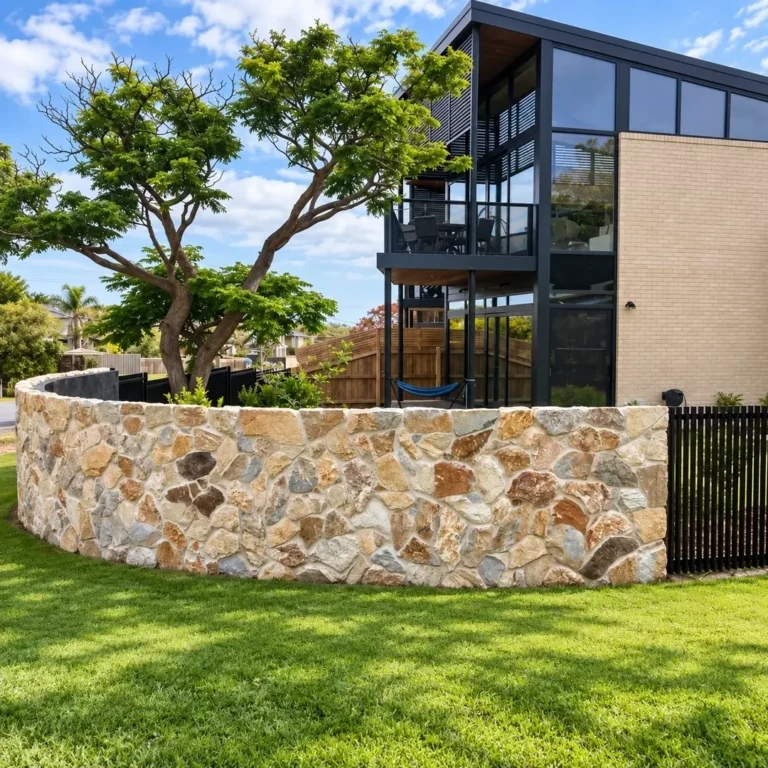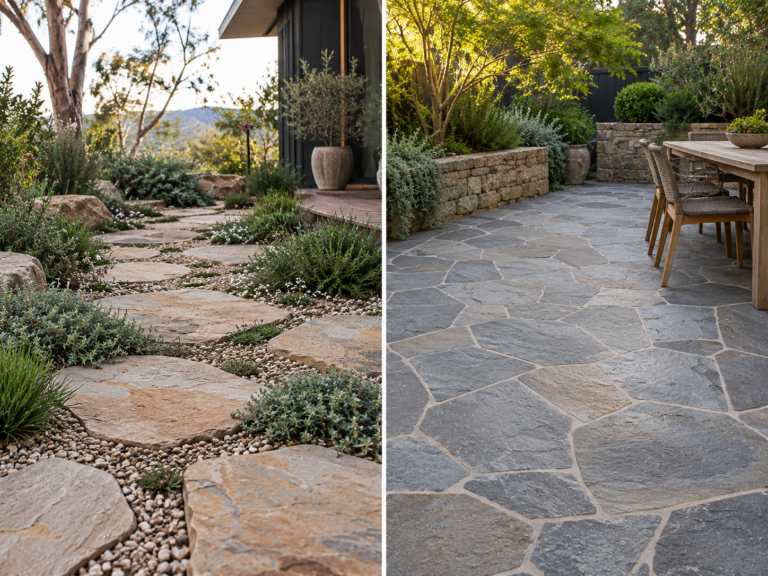


Natural stone paving gives Melbourne homes and landscapes a durable surface with genuine colour, texture and variation. Bluestone, travertine, limestone, sandstone and granite can be used across patios, courtyards, garden paths, pool surrounds and other outdoor areas when the stone, finish and installation method suit the application.
Splendour In Stone supplies natural stone paving, cobblestones, walling and cladding for residential and commercial projects. The right material depends on the site, expected traffic, surrounding architecture, moisture exposure and the appearance you want to create.
This guide compares the main natural stone pavers available for Melbourne projects, explains where each material works best and outlines installation, cost, maintenance and ordering considerations.
Natural stone paving in Melbourne at a glance
The best natural stone paving for a Melbourne property depends on how the area will be used.
Bluestone and granite are often considered for areas requiring a strong architectural appearance. Travertine and limestone create a softer, lighter surface for courtyards and outdoor living spaces. Sandstone introduces warmer earthy colour, while cobblestones suit borders, pathways and areas where a smaller-format stone is preferred.
| Natural stone | Typical appearance | Common applications | Main consideration |
| Bluestone | Grey, charcoal and blue-grey | Courtyards, paths, entrances and driveways | Finish and slip resistance |
| Travertine | Cream, beige, silver and walnut | Patios, courtyards and pool areas | Porosity and sealing |
| Limestone | Pale cream, beige and grey | Entertaining areas, paths and courtyards | Product-specific density and finish |
| Sandstone | Cream, gold, brown and earthy blends | Garden paths, patios and traditional landscapes | Moisture absorption and maintenance |
| Granite | Grey, charcoal and speckled tones | Entrances, driveways and high-use areas | Weight, cutting and installation |
| Cobblestone | Mixed colour depending on stone | Borders, paths, driveways and detailed layouts | Jointing and base preparation |
These are general applications rather than universal specifications. The selected product, thickness and finish must be checked against the intended use before ordering.
Natural stone pavers available for Melbourne projects

Splendour In Stone’s natural stone paving range includes materials suited to different architectural styles and outdoor applications.
A successful selection starts with more than colour. Consider the stone’s format, surface texture, thickness, edge profile, exposure conditions and expected traffic.
Bluestone pavers
Bluestone pavers are commonly used in Melbourne because their grey and blue-grey tones complement contemporary homes, heritage properties, concrete, timber and dark metal detailing.
They can create a controlled architectural surface without appearing overly uniform. Natural markings and tonal variation give the paving more depth than a manufactured grey product.
Sawn Bluestone offers a clean, refined appearance for projects where straight lines and a contemporary finish are important. Flamed Bluestone provides another surface option for exterior paving, subject to confirming its suitability for the specific location.
Bluestone is often considered for:
- Front entrances
- Courtyards
- Garden paths
- Outdoor entertaining areas
- Stepping-stone routes
- Driveways using the correct product specification
For driveways and other vehicle areas, confirm the required stone thickness, substrate and installation method. A product suitable for a pedestrian courtyard should not automatically be assumed suitable for vehicle traffic.
Travertine pavers
Travertine has a softer and lighter appearance than bluestone or granite. Its cream, beige, walnut and silver tones work well in relaxed courtyards, Mediterranean-inspired gardens and outdoor entertaining areas.
Classic Travertine provides a warm neutral palette, while Silver Travertine introduces cooler grey and beige variation.
Travertine pavers are commonly considered for:
- Patios
- Courtyards
- Alfresco areas
- Garden paths
- Pool surrounds using an appropriate finish
- Indoor-to-outdoor transitions
Travertine is porous, so sealing and moisture management should be considered during product selection. Pool areas also require careful attention to slip resistance, coping details, drainage and compatibility with the pool environment.
Limestone pavers
Limestone pavers create a calm, understated surface that works comfortably with rendered homes, timber, soft landscaping and other natural materials.
The colour can range from pale cream and beige to deeper grey. This makes limestone flexible enough for modern, coastal, country and traditional landscapes.
Options such as Loch Limestone and Sienna Limestone provide different tones to compare against the surrounding architecture.
Limestone may be suitable for:
- Courtyards
- Covered outdoor areas
- Garden paths
- Patios
- Entertaining spaces
- Low-traffic residential landscapes
Not all limestone performs identically. Density, finish, thickness and exposure suitability can vary between products. Assess the actual stone rather than relying only on the material name.
Sandstone pavers
Sandstone brings warm cream, honey, gold, brown and earthy colours into the landscape. It is particularly effective around gardens, brick homes, timber structures and traditional architecture.
Sandstone pavers may be considered for:
- Garden paths
- Patios
- Courtyards
- Stepping-stone routes
- Informal entertaining areas
- Landscapes with sandstone walling
Because sandstone is porous, correct drainage, base preparation, cleaning and sealing can have a significant effect on long-term performance. Confirm current sandstone paving formats and their intended applications with the supplier before finalising the design.
Sandstone paving can also be coordinated with products such as Charlotte Sandstone or Australiana Sandstone on nearby garden walls and built landscape features.
Granite pavers
Granite creates a strong, structured appearance suited to contemporary homes, formal entries and high-use outdoor areas.
Its colour may include grey, charcoal, silver and darker mineral variation. Grey Granite can be considered where a neutral paving surface needs to complement concrete, render or modern exterior finishes.
Granite is often selected for:
- Entrances
- Courtyards
- Paths
- Driveways using a suitable format
- Commercial outdoor spaces
- High-traffic pedestrian areas
Granite can be heavy and may require more cutting effort than softer stones. Base preparation and professional handling become increasingly important as unit size and project scale increase.
Which natural stone is best for your project?
There is no single best stone paver for every Melbourne property. The strongest choice is the material that suits the application, architecture, maintenance expectations and installation conditions.
| Project area | Materials commonly considered | What to confirm |
| Patio | Travertine, limestone, sandstone or bluestone | Finish, furniture loads and drainage |
| Courtyard | Bluestone, travertine, limestone or granite | Visual scale, joint pattern and surface finish |
| Garden path | Sandstone, limestone, bluestone or cobblestone | Unit size, curves and edge restraint |
| Pool surround | Travertine, limestone or selected bluestone | Slip resistance, heat, sealing and coping |
| Driveway | Granite, bluestone or cobblestone | Thickness, traffic load, base and laying system |
| Front entrance | Bluestone, granite, limestone or travertine | Steps, wet-weather grip and coordination with façade |
| Raised garden wall | Sandstone, limestone, quartz or other walling stone | Substrate, drainage, capping and fixing system |
| Feature wall | Natural stone cladding selected for the architecture | Substrate, adhesive, corners and weather exposure |
A paving sample should be viewed outdoors beside the building materials already on site. Stone can appear noticeably different in full sun, shade and wet conditions.
The final choice also needs to account for installation. This is why choosing the right stone paving involves balancing appearance with application, site conditions and long-term care.
Natural stone walling and cladding in Melbourne

Natural stone walling uses stone to form or finish vertical landscape and architectural features. It may be used for retaining walls, raised garden beds, entry walls, façades, fireplaces and freestanding landscape elements.
Stone cladding is different from solid walling. Cladding is fixed to a suitable structural substrate, while solid walling stone may form a larger part of the wall itself.
Splendour In Stone’s natural stone walling range includes materials that can be coordinated with nearby paving to produce a consistent outdoor palette.
Walling and cladding may be used for:
- Raised garden beds
- Retaining wall finishes
- Front entrance walls
- Pillars
- Outdoor fireplaces
- Façades
- Courtyard feature walls
- Landscape seating walls
A stone wall does not need to match the paving exactly. A related tone with a different texture can create more depth than repeating the same finish across every surface.
For example, pale paving may be paired with warmer sandstone walling, while grey bluestone paving can sit beside a contrasting quartz or limestone feature wall.
Structural requirements, drainage and capping must be addressed before cladding is selected. A wall retaining soil should be designed as a retaining structure rather than treated as a decorative stone surface. The planning considerations in this Australian stone retaining wall guide are particularly relevant where the landscape includes changes in level.
Cobblestones and crazy paving
Cobblestone pavers
Cobblestones are smaller stone units that create a more textured and detailed surface than large-format paving.
They work well for:
- Garden paths
- Driveway borders
- Courtyard detailing
- Curved layouts
- Feature bands
- Transitions between materials
- Traditional and European-inspired landscapes
The cobblestone collection includes options such as Porphyry Cobble, which brings mixed natural colour and small-format texture into a landscape.
Cobblestone paving requires careful jointing and edge restraint. The number of joints also makes base preparation and installation consistency important.
Crazy paving
Crazy paving uses irregular stone pieces fitted together to form an organic pattern. It suits courtyards, garden paths, outdoor entertaining areas and landscapes where a regular grid would feel too formal.
Euro Crazy Paving and Porphyry Crazy Paving provide different colour and texture options for irregular layouts.
A successful crazy paving installation depends on:
- Balanced stone sizes
- Controlled joint widths
- Careful cutting and fitting
- Even surface levels
- Suitable grout or jointing material
- A stable prepared substrate
The layout should look irregular without appearing random or poorly planned. Large pieces, medium pieces and smaller infill stones need to be distributed across the complete area.
How natural stone paving installation works

Natural stone paving installation generally involves site assessment, excavation, base preparation, layout planning, laying, jointing, cleaning and sealing where appropriate.
The exact system depends on the stone, unit thickness, substrate, traffic load and site conditions.
1. Assess the site
The installer should identify:
- Existing ground conditions
- Required excavation
- Surface levels
- Drainage direction
- Access for materials and equipment
- Connections to doors, steps and paths
- Expected pedestrian or vehicle loads
This stage should happen before the paving is ordered because the installation system may affect the required stone thickness and quantity.
2. Excavate to the required depth
Existing soil, lawn, old paving or unsuitable base material is removed.
The excavation depth must allow for the sub-base, bedding layer, paver thickness and finished surface level. Driveways and unstable ground generally require more substantial preparation than a low-traffic pedestrian path.
3. Prepare and compact the base
A stable base reduces settlement, rocking and uneven joints.
The appropriate materials depend on whether the stone will be installed over compacted ground, mortar or a concrete substrate. The natural stone bedding materials guide explains why the bedding system must be matched to the stone and intended application.
Thorough ground preparation for stone installation is particularly important on reactive soil, filled ground and areas affected by drainage.
4. Set out the paving pattern
The installer should dry-plan the layout before laying begins.
This helps control:
- Cut sizes
- Joint alignment
- Pattern direction
- Colour distribution
- Connections to walls and steps
- Placement around drains and services
Natural variation should be blended across the complete area rather than installing one pallet or crate at a time without mixing.
5. Lay and level the stone
Each paver is set according to the specified installation system.
The installer checks the surface level, fall, joint width and support beneath each unit. Voids beneath stone can contribute to cracking, movement and hollow areas.
6. Fill and finish the joints
The jointing material must suit the stone, joint width and location.
Mortar, grout, sand and other jointing systems perform differently. Excess material should be removed before it stains or hardens on the stone face.
7. Clean and seal where required
Installation residue must be removed with products suitable for natural stone.
Sealing may be recommended for porous materials or areas exposed to food, moisture, organic matter and regular use. The selected sealer should suit the stone, finish and intended appearance.
A qualified paving contractor or landscaper should confirm the final specification. Splendour In Stone can supply the selected stone and relevant product information, while installation responsibility and available installer support should be confirmed during the quotation process.
How much does natural stone paving cost in Melbourne?
Natural stone paving costs in Melbourne depend on the stone, project area, installation method, site access and preparation required.
A dependable estimate cannot be based on the paver price alone. The complete cost may include:
- Stone supply
- Delivery and unloading
- Excavation
- Waste removal
- Sub-base materials
- Concrete or mortar where required
- Labour
- Cutting
- Jointing
- Edge restraint
- Drainage work
- Cleaning
- Sealing
- Wastage allowance
Stone selection
Natural stone materials and formats are priced differently. Large pieces, thick driveway units, custom sizes and heavily processed finishes may cost more to supply and handle.
Project size
A larger area requires more material, base preparation and labour. However, very small projects can still have relatively high setup, cutting and delivery costs.
Site preparation
Removing existing concrete, correcting drainage or stabilising weak ground can significantly affect the total cost.
Access
Narrow side access, stairs, steep blocks and limited unloading space increase manual handling.
Pattern and cutting
Straight rectangular paving is generally simpler to lay than intricate curves, small borders or irregular crazy paving.
Installation system
Paving laid over a concrete slab involves different materials and labour from paving laid over a compacted base.
To compare quotations properly, make sure each supplier or contractor has priced the same:
- Stone product
- Area
- Thickness
- Installation system
- Base preparation
- Jointing method
- Sealing requirements
- Delivery conditions
A quote that includes only the paving material cannot be compared directly with one that includes excavation, laying and finishing.
Do natural stone pavers need sealing?
Many natural stone pavers benefit from sealing, but the answer depends on the stone, finish and location.
A suitable penetrating sealer may reduce the absorption of water, oils, food, leaves and other staining materials. It does not make natural stone stain-proof or maintenance-free.
Sealing is commonly considered for:
- Pool surrounds
- Outdoor kitchens
- Entertaining areas
- Pale porous stone
- Areas beneath trees
- High-use entrances
- Paving exposed to food and drink
The stone should be clean and sufficiently dry before sealing. Applying an unsuitable product or sealing installation moisture into the stone can affect the appearance.
Follow product-specific advice rather than applying one sealing schedule to every natural stone. Regular sweeping, appropriate cleaning and prompt stain treatment remain important after sealing.
The same principles covered in the paver cleaning and maintenance guide can help protect the finished surface without relying on harsh chemicals or aggressive cleaning methods.
Natural stone paving for Melbourne’s climate
Melbourne’s weather can expose outdoor paving to strong summer sun, cool wet periods, wind, leaf matter and repeated temperature changes.
A well-performing paving system needs:
- Effective drainage
- Correct falls
- Stable base preparation
- Exterior-grade jointing materials
- A stone suited to the exposure
- Suitable movement detailing
- Regular cleaning
- Sealing where appropriate
Shaded paving may remain damp for longer and develop organic growth more quickly. Areas beneath trees may be exposed to leaves, sap, fruit and bird activity. Pool surrounds face water, chemicals and regular barefoot traffic.
These conditions should influence the stone, finish and maintenance plan. A material chosen only from an indoor showroom sample may behave differently once installed in an exposed Melbourne garden.
Ordering natural stone paving in Melbourne
Before requesting a quote, collect the information needed to identify an appropriate product and quantity.
Provide:
- Project address or postcode
- Total area in square metres
- Intended application
- Site photographs
- Preferred material and colour
- Expected pedestrian or vehicle use
- Indoor, covered or fully exposed location
- Pool or water exposure
- Proposed installation system
- Required delivery timing
- Access and unloading details
Allow extra material for cutting, breakage, pattern matching and natural variation. The appropriate wastage allowance depends on the paver format and layout.
Order samples before committing to a large quantity. View several pieces together outdoors and compare them with the façade, roof, render, brick, timber, fencing and planting.
Projects outside central Melbourne can be assessed according to stock, quantity, transport requirements and delivery access. The Victoria location directory provides further information for customers planning natural stone projects across different areas.
Why choose Splendour In Stone?
Splendour In Stone supplies natural stone for paving, walling, cobblestone and architectural applications.
Customers can compare:
- Bluestone
- Travertine
- Limestone
- Sandstone
- Granite
- Marble
- Quartz and quartzite
- Cobblestones
- Crazy paving
- Walling and cladding
- Reclaimed materials
The advantage of working with a specialist stone supplier is the ability to compare genuine natural materials rather than selecting from one manufactured paving category.
Material selection can also consider surrounding walls, steps, pool coping, garden borders and architectural features at the same time. This helps avoid choosing paving in isolation and trying to match the rest of the landscape later.
Plan your Melbourne natural stone project

The best natural stone paving combines suitable material, correct installation and a design that belongs with the property.
Bluestone, travertine, limestone, sandstone and granite each create a different atmosphere. Cobblestones and crazy paving add smaller-scale texture, while natural stone walling can connect the ground surface with raised beds, façades and landscape features.
Measure the area, photograph the site and identify how the surface will be used before selecting a product. Samples should then be assessed outdoors under the same light and conditions as the proposed installation.
For product availability, samples, delivery details and project-specific recommendations, contact Splendour In Stone with your measurements, site photographs and preferred stone options.
Frequently asked questions
1. What is the best natural stone paving for Melbourne homes?
The best natural stone paving depends on the application and preferred appearance.
Bluestone and granite suit strong architectural designs, travertine and limestone create lighter outdoor areas, and sandstone provides warm natural colour. Pool areas, driveways and exposed entrances require product-specific checks for thickness, finish, moisture and traffic.
2. Does Splendour In Stone install natural stone paving?
Splendour In Stone supplies natural stone paving and walling products. Confirm current installation support, contractor recommendations and project responsibilities when requesting a quote, as these may depend on the location and type of work.
3. Are bluestone pavers suitable for Melbourne driveways?
Bluestone may be suitable for a driveway when the selected product has the correct thickness, strength and surface finish and is installed over a base designed for vehicle traffic.
A standard patio paver should not automatically be used for a driveway without confirming the specification.
4. Is travertine or limestone better for a patio?
Travertine often provides visible movement and warm tonal variation, while limestone can create a calmer and more understated surface.
The better choice depends on the product, finish, exposure, maintenance expectations and surrounding architecture rather than the stone name alone.
5. What is the best natural stone for a pool surround?
Travertine, limestone and selected bluestone products are commonly considered for pool surrounds.
The final choice should account for slip resistance, surface temperature, water absorption, pool chemicals, sealing, coping and drainage.
6. How long does natural stone paving installation take?
Installation time depends on the project area, site access, excavation, base preparation, paving format and weather.
A straightforward courtyard on a prepared site will usually require less time than a driveway, raised terrace or irregular crazy paving installation.
7. How much extra stone should I order?
Extra stone is normally required for cuts, breakage, selection and future repairs.
The correct allowance depends on the paving format, pattern, project shape and number of cuts. Confirm the recommended percentage with the supplier and installer before placing the order.
8. Can natural stone paving be installed over existing concrete?
Natural stone may be installed over an existing concrete slab if the slab is stable, suitably graded and compatible with the proposed installation system.
Cracks, movement, drainage problems and finished height must be assessed first. An unsuitable slab should not simply be covered.
9. Do natural stone pavers fade?
Natural stone does not fade in the same way as a surface coating, but its appearance can change through weathering, moisture, dirt, sealing and mineral variation.
Correct cleaning and maintenance help preserve the intended finish.