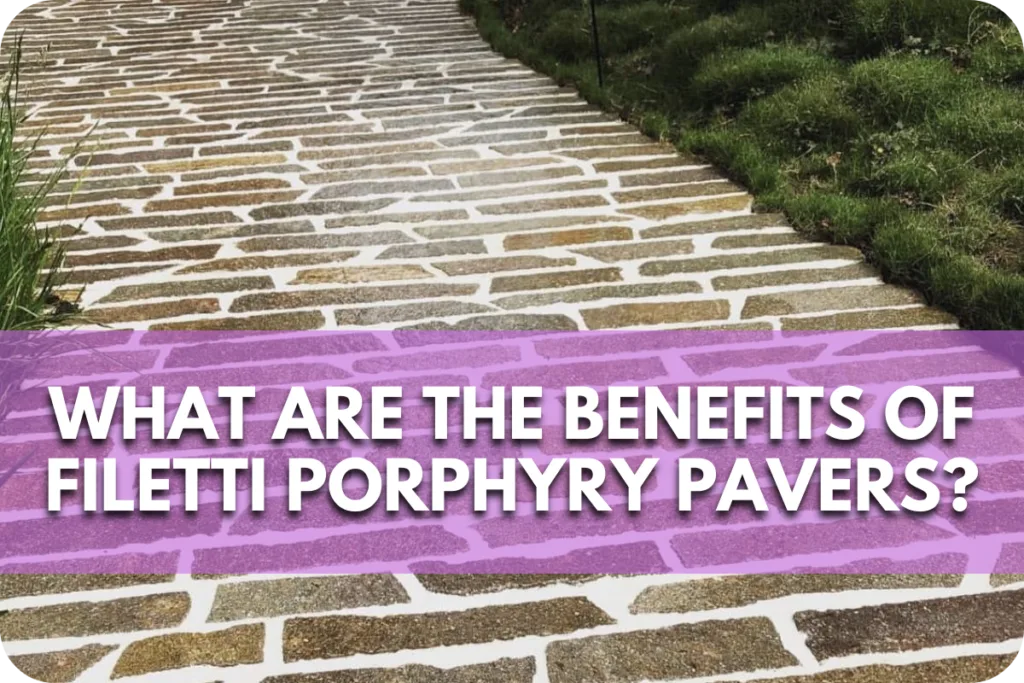
Filetti porphyry pavers are narrow strips of natural porphyry, typically 150 to 300mm long, 30 to 80mm wide and 30 to 50mm thick, laid in courses, fans or random bonds.
Their benefits come from the stone and the shape working together: porphyry supplies the hardness, slip resistance and colourfastness, while the strip format handles curves, slopes and driveways that larger pavers struggle with.
This guide explains what filetti is, the seven benefits that matter in practice, and how the format compares with porphyry cobbles and crazy paving.
In this guide
What Is Filetti Porphyry?
Filetti (Italian for “small strips” or “fillets”) is porphyry split into slender, elongated pieces with a naturally riven surface. Laid tightly in rows or fanned patterns, the random lengths create a strong sense of rhythm and movement across a surface, in a rustic blend of plum, bronze, grey and charcoal tones.
The stone itself is volcanic, formed under heat and pressure, which makes it one of the hardest paving materials available; the background is covered in what is porphyry. The format and current sizes are on the Porphyry Filetti product page.
7 Benefits of Filetti Porphyry Pavers
1. It is genuinely hard-wearing under vehicles
Porphyry’s density and abrasion resistance make filetti a working driveway surface, not just a decorative one. At 30 to 50mm thick on a properly built base, it handles daily vehicle movements without rutting or surface wear; how the stone performs under sustained load is covered in porphyry and outdoor traffic.
2. Slip resistance is built in, not applied
The split (riven) face of each strip provides natural texture that grips underfoot and under the tyre in the wet, with no coatings or treatments to wear off. That makes filetti a strong pick for ramps, slopes and shaded paths that stay damp.
3. The colour cannot fade
Filetti’s plum, bronze, grey and charcoal tones are the minerals of the stone itself, running through the full thickness of every piece. There is no pigment or surface layer for UV to break down, so the surface weathers rather than fades.
4. The strip format follows curves and patterns
Small, narrow units track around radii, garden beds and circular driveways without awkward cutting, and they suit the classic fan and arc patterns that large-format pavers cannot form. If you are weighing up layouts, see the popular paver patterns in Australia.
5. Maintenance is minimal
Porphyry’s low water absorption means stains struggle to penetrate, and sealing is rarely required. A sweep and an occasional wash keep filetti presentable, and coastal salt spray does not trouble the stone.
6. The lifecycle economics stack up
Porphyry has surfaced European streets and piazzas for centuries, and the same longevity applies at home: a filetti driveway is a one-time surface. Against materials that need resurfacing or replacement every couple of decades, the higher upfront spend amortises well.
7. It reads as quality to buyers
Hand-laid natural stone in a distinctive format is immediately legible as a premium feature from the street. It is the kind of hard landscaping that photographs well in a listing and survives changing trends, because the look is geological rather than fashionable.
For the stone’s advantages independent of format, see the broader benefits of porphyry pavers.
Filetti vs Porphyry Cobbles vs Crazy Porphyry
Same stone, three formats, three different jobs.
| Format | Shape | Best for |
| Filetti | Narrow strips, 150 to 300mm long | Driveways, fans and arcs, curves, borders |
| Cobbles | Small square setts | Heritage driveways, edging, aprons |
| Crazy paving | Irregular flat pieces | Patios, courtyards, garden paths |
Filetti sits between the two visually: more linear and rhythmic than crazy paving, finer-grained and more contemporary than cobbles.
Where Do Filetti Porphyry Pavers Work Best?
- Driveways and crossovers, where hardness, traction and a hand-laid look justify the format.
- Sloped paths and ramps, which benefit from the riven grip and small-unit flexibility.
- Courtyards and entries, where the fan and course patterns become the design feature.
- Pool surrounds and steps, paired with matching edge details; see the porphyry pool coping guide.
- Walkways and public spaces, where councils and designers use porphyry precisely because it ignores traffic; options are compared in porphyry pavers for walkways.
How Are Filetti Pavers Laid?
Filetti is a hand-set format. For driveways and trafficked areas, it is laid on a mortar bed over a concrete slab with grouted joints, which locks the small units against turning wheels. Pedestrian areas can be laid flexibly over a compacted road base.
Either way, the strips are placed piece by piece in courses or fans, which is where the labour (and the character) sits. The base, bedding and jointing fundamentals are the same as any stone paving and are covered in the stone paver installation and repair guide.
See Filetti in the Flesh
Photos flatten the texture and tone variation that make filetti work. Order samples to see the plum, bronze, grey and charcoal blend against your home’s materials before you commit.
FAQs
What does filetti mean?
Filetti is Italian for “small strips” or “fillets”. In paving, it refers to porphyry split into narrow, elongated pieces of random length, laid tightly in rows, fans or arcs.
Is filetti porphyry good for driveways?
Yes, it is one of the best natural stone driveway formats: hard enough for daily vehicle traffic, naturally slip-resistant, and small enough to follow curved driveways without heavy cutting. It needs a properly built base or slab, like any trafficked surface.
Does porphyry need sealing?
Rarely. Porphyry’s low water absorption means most installations are left unsealed, with sealing reserved for settings where oil staining is a concern, such as parking bays or outdoor kitchens.
Is filet mignon expensive to install?
The material is competitively priced for premium stone; the real cost is the hand-laying, since every strip is placed individually. Budget more for labour than you would for large-format pavers, and treat the installer’s track record with small-format stone as part of the spec; our guide to choosing a porphyry supplier covers what to check.