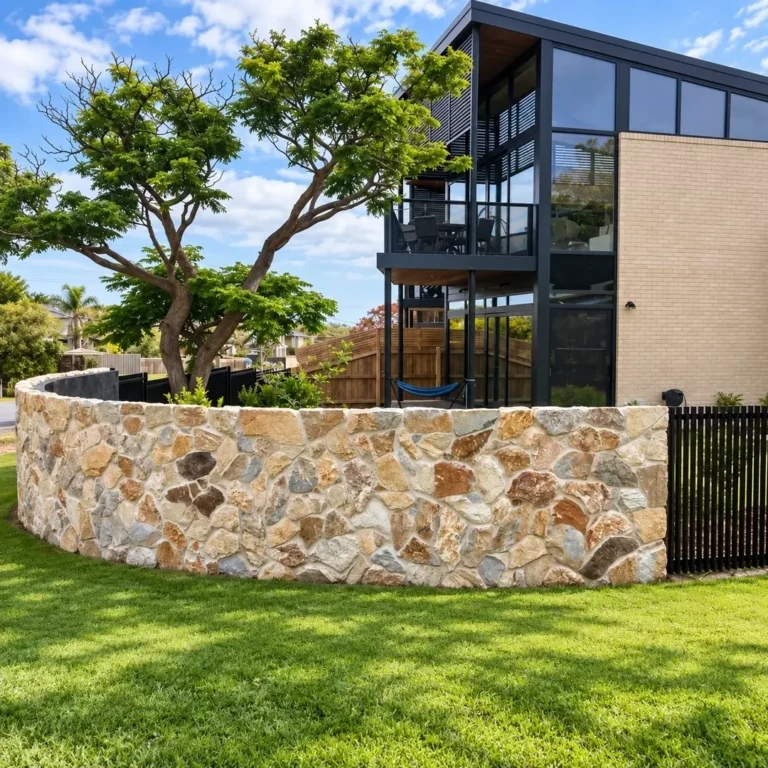
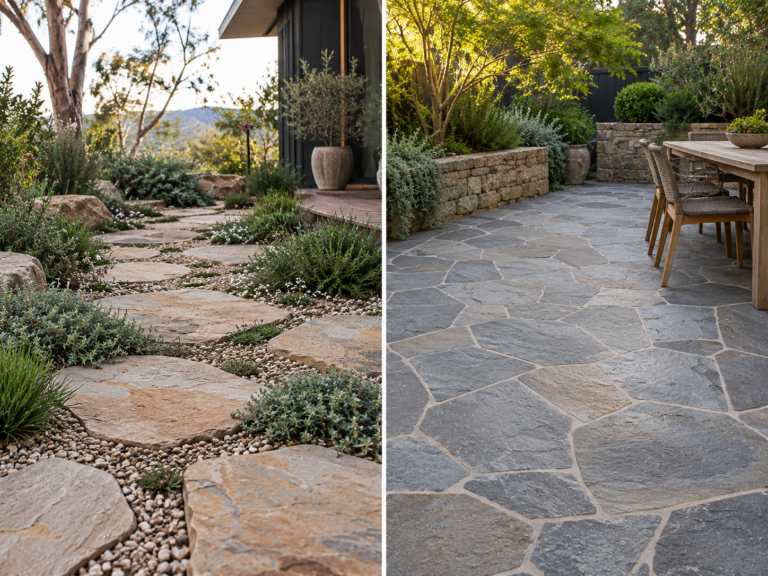
Beloka limestone is an Australian natural stone valued for its cool charcoal base, warm bronze and gold highlights, and fractured free-form character. It’s specified across Australian residential and commercial projects for walling, cladding, feature walls, and exterior facades, particularly where designers want a stone that reads as both rugged and refined.
This review covers what specifiers actually need to know: durability under Australian conditions, expected lifespan, seismic and weather performance, interior and exterior design applications, care requirements, and how Beloka compares to other limestones commonly available in Australia.
Quick Specs at a Glance
| Specification | Detail |
| Stone type | Sedimentary limestone (calcium carbonate) |
| Origin | Australia |
| Colour palette | Cool charcoal base with bronze and gold highlights |
| Surface character | Fractured, weathered, oxidised appearance |
| Available format | Free-form, large irregular pieces |
| Common finishes | Natural split, tumbled |
| Best installation styles | Dry stack, grouted joints |
| Primary applications | Walling, cladding, feature walls, facades |
| Suitable for | Interior and exterior |
| Sealing requirement | Yes, penetrating sealer recommended |
| Expected lifespan (sealed) | 50 to 100+ years for cladding applications |
What is Beloka Limestone

Beloka is a sedimentary limestone, formed over millions of years from compressed calcium carbonate deposits. What sets it apart visually is its colour layering. The base reads as a cool charcoal blue-grey, broken up by bands and patches of warm bronze and oxidised gold.
The fractured surface texture mimics naturally weathered stone, so it lands somewhere between rustic and contemporary depending on how it’s installed.
It’s supplied in free-form pieces rather than uniform tiles or blocks. Large, irregular shapes are the signature, which suits dry-stack walling and grouted random ashlar patterns. The visual variation means no two walls look identical, and the stone develops a richer patina over years of exposure.
For projects calling for a stone with weight and character (rather than uniformity), Beloka is one of the more distinctive options available locally.
How Beloka Limestone Performs
Limestone is often dismissed as too soft for serious exterior work. With Beloka, that assumption needs nuance. Performance depends heavily on installation method, sealing and the specific demands of the site, especially when assessing limestone durability for Australian conditions.
Resistance to Acid Rain and Australian Weather
Limestone is calcium carbonate, which reacts to acidic conditions. In practical terms, this means Beloka can experience surface etching when exposed to acid rain or acidic cleaning products over time.
The good news for Australian projects: acid rain levels across most Australian cities sit well below the thresholds that cause visible damage to limestone over a building’s lifespan. Coastal salt exposure and UV are bigger concerns for most installations than rainfall acidity.
A quality penetrating sealer applied at installation and reapplied every three to five years (depending on exposure) significantly reduces porosity and slows any chemical weathering. Without sealing, you’ll see gradual softening of edges and a slight patina shift over decades. With sealing, Beloka holds its character reliably across Australian climates, including coastal and high-UV inland environments.
Expected Lifespan
For exterior cladding and walling, properly sealed and installed Beloka limestone can last 50 to 100 years or more. Heritage limestone buildings across Europe demonstrate the stone’s potential longevity when specified and maintained correctly.
Lifespan shortens where the stone is exposed to heavy mechanical wear, persistent moisture without drainage, or repeated freeze-thaw cycles (less common in most of Australia, but a factor in alpine regions). Interior applications, particularly feature walls and fireplace surrounds, can effectively last the life of the building with minimal intervention.
Performance in Seismic and High-Movement Conditions
Beloka can be specified for exterior cladding in seismic-active regions, but the stone itself isn’t doing the heavy lifting. What matters is the fixing system. Rigid attachments fail under seismic stress. Flexible anchoring (seismic clips, stainless steel brackets, mechanically fixed systems with movement tolerance) allows the cladding to absorb building movement without cracking or detachment.
Specifiers should reference AS 3700 for masonry and consult a structural engineer for any cladding project in higher-seismic zones. Reinforced backing (steel-framed substrates, fibre cement boards) and properly designed expansion joints distribute load and reduce localised stress. Done correctly, Beloka cladding performs in seismic conditions. Done with standard rigid fixings, it won’t.
Design Applications

Beloka’s strength as a design material comes from its visual depth. The charcoal-and-bronze palette reads as moody and grounded, which makes it work in spaces where lighter limestones would feel out of character.
Creating a Statement Interior with Beloka
For interiors, Beloka pairs best with materials that complement its tonal complexity rather than competing with it. Think raw timber (oak, blackbutt, spotted gum), aged brass, matte black metal, and warm neutral plaster finishes. Soft, indirect lighting brings out the bronze flecks. Harsh overhead lighting flattens it.
Interior applications where Beloka performs particularly well:
- Fireplace surrounds. The fractured texture catches firelight, and the charcoal base reads as substantial without feeling cold.
- Feature walls in living rooms. Full-height dry-stack installations create depth in open-plan spaces.
- Entry walls and foyers. First impressions benefit from the stone’s tactile weight.
- Powder room feature walls. A confined space lets the stone’s character take centre stage.
- Staircase cladding. Wraps a vertical surface in continuous texture.
- Wine cellar walls. The cool tones suit the function and atmosphere.
- Bar fronts and back walls. Hospitality fit-outs use Beloka for moody, sophisticated finishes.
Exterior Applications That Last
Outdoors, Beloka comes into its own. The stone’s natural weathered look means it ages without looking tired, and exposure to the elements deepens the patina rather than damaging the aesthetic.
Facade cladding is the most common exterior application, particularly on contemporary homes where designers want texture and shadow to break up large planar walls. Garden walls and retaining walls suit the free-form format perfectly, with dry-stack installations giving a permanent, established feel from day one.
Pier caps and entry walls frame driveways and front gates with weight and substance. Pool surrounds and feature courtyard walls extend the indoor-outdoor connection, where a Beloka feature wall continues from inside to out.
For coastal projects, sealing is non-negotiable. Salt accelerates surface degradation on unsealed limestone, but a properly specified marine-grade sealer extends performance significantly.
Beloka Limestone vs Other Australian Limestones
| Stone | Colour | Texture | Best For | Visual Character |
| Beloka | Cool charcoal with bronze and gold | Fractured, free-form | Walling, cladding, feature walls | Rugged, weathered, moody |
| Jamieson | Cool grey and beige | Natural split | Refined walling, heritage facades | Subtle, classic |
| Barwon | Pale, lightly speckled | Sawn or honed | Bright facades, walling | Clean, contemporary |
| Jasper | Cream to honey with veining | Sawn or tumbled | Bold walling, feature walls | Warm, textured |
| Marrakesh | Sandy beige and brown | Patina finish | Mediterranean, rustic walls | Earthy, traditional |
Beloka sits at the darker, more dramatic end of the Australian limestone spectrum. If a project calls for brightness or uniformity, lighter limestones suit better. If it calls for texture, depth, and visual weight, Beloka does what most other limestones can’t.
Care and Maintenance

Beloka is straightforward to maintain when the right protocol is in place from day one. Get the sealing and cleaning routine right early, and the stone holds its character for decades with minimal intervention.
- Seal at installation. Apply a quality penetrating sealer immediately after install. For exterior projects, use a marine or weather-grade product. Skip topical sealers, which can alter the natural finish.
- Reseal every 3 to 5 years. Interior walls can stretch closer to 5 years. Exterior and coastal applications need more frequent attention, particularly in the first decade.
- Clean with pH-neutral products only. Avoid vinegar, citrus cleaners, bleach, and any acidic product. These etch limestone surfaces, sometimes permanently.
- Address spills promptly. Wine, coffee, and oil-based liquids can stain if left to soak. Blot, don’t wipe, then clean with warm water and a pH-neutral stone soap.
- Inspect annually. Check for missing grout, hairline cracks, or sealer breakdown. Early intervention prevents larger issues.
- Engage a stone restoration specialist for any significant staining, etching, or structural movement. DIY repair on natural stone often makes problems worse.
Pros and Cons
| Strengths | Considerations |
| Distinctive charcoal and bronze colour palette | Requires sealing for long-term performance |
| Free-form pieces create unique installations | Softer than granite or basalt |
| Performs in interior and exterior applications | Reactive to acidic cleaners |
| Develops attractive patina over time | Free-form pieces require skilled installation |
| Suitable for seismic-zone cladding with proper fixings | Higher labour cost than uniform tile formats |
| Locally available, reducing lead times | Visual variation may not suit minimalist briefs |
Specifying Beloka Limestone for Your Project
Beloka suits projects where character, weight, and texture matter more than uniformity. It’s not the right call for every brief, but for the projects it fits, few other Australian limestones come close on visual impact. For samples, technical specifications, or trade pricing, the Splendour in Stone team can match Beloka to your project requirements and supply across Australia.
Frequently Asked Questions
1. Is Beloka limestone suitable for outdoor use in Australian climates?
Yes. Beloka performs well across Australian climates, including coastal, urban, and high-UV inland environments when sealed properly. Sealing every three to five years protects against moisture, salt, and surface weathering. Coastal projects benefit from marine-grade sealers and slightly more frequent reapplication.
2. How often does Beloka limestone need to be sealed?
For interior applications, every five years is generally sufficient. Exterior walling and cladding typically need resealing every three years, with coastal installations closer to two. A quick water-bead test on the surface tells you when reapplication is due: if water absorbs rather than beads, it’s time.
3. Can Beloka limestone be used for cladding in seismic-active areas?
Yes, with the right fixing system. Rigid attachments fail under seismic stress, so flexible anchoring (seismic clips, mechanically fixed brackets, reinforced substrates) is essential. Consult a structural engineer for any seismic-zone cladding project and reference AS 3700 for compliance.
4. Does Beloka limestone change colour over time?
The stone develops a deeper, richer patina over years of exposure. The charcoal base softens slightly, and the bronze and gold highlights become more pronounced as the surface weathers naturally. Sealed installations weather more slowly and predictably than unsealed ones.
5. Is Beloka limestone more expensive than other Australian limestones?
Pricing varies based on quantity, finish, and project complexity. Free-form stones like Beloka typically cost more to install than uniform tile formats because of the skilled labour required for dry-stack and random ashlar patterns. Material costs sit in the mid-to-upper range of Australian limestone options.