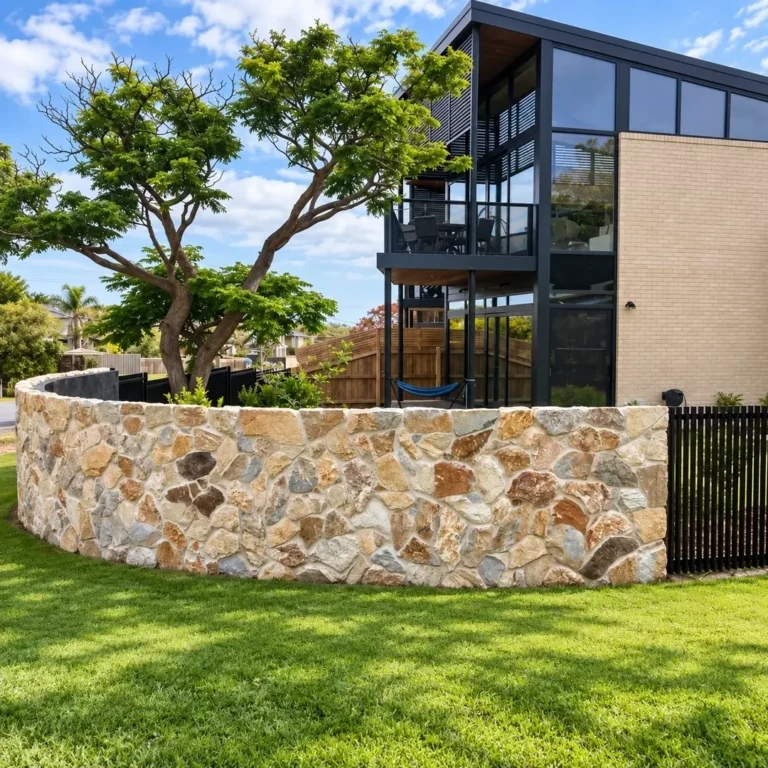
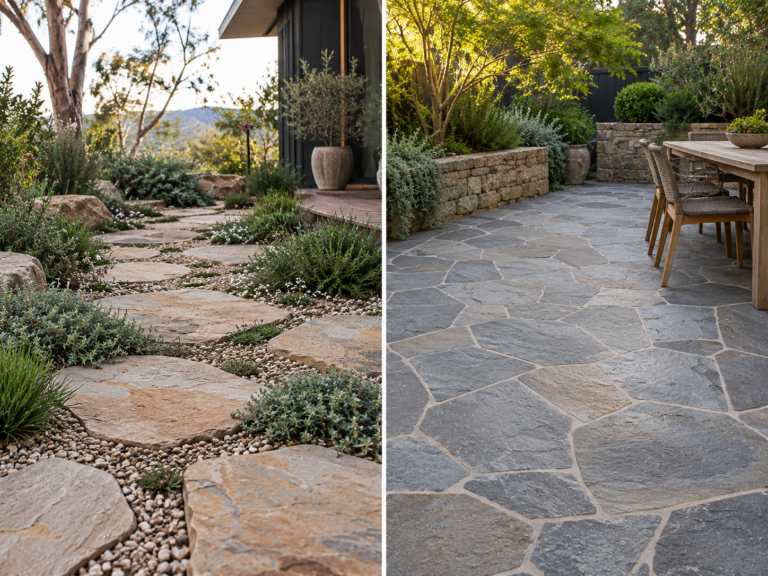
The most durable wall cladding materials in Australia are natural stone, brick and fibre cement. All three routinely last 50 years or more, and all three are non-combustible or deemed non-combustible under the National Construction Code. Natural stone leads the group on combined lifespan, weather resistance and fire performance because it does not rot, warp, corrode or fade.
This guide compares every major cladding material on service life, maintenance and fire performance, then covers the stones, installation details and care routines that decide whether your cladding lasts 20 years or 70.
What Makes Wall Cladding Durable?
Durable wall cladding is cladding that resists the main causes of failure: moisture, UV exposure, thermal movement, salt and fixing breakdown. The material matters, but so does the system holding it to the wall.
Cladding works as a protective skin over the structure, taking the weather so the wall behind it does not have to. If you are starting from scratch, our explainer on what wall cladding is covers the basics. For durability, judge any material against these five stresses:
- Moisture. Water drives rot in timber, corrosion in steel fixings and spalling in porous materials that freeze while wet. The best claddings either absorb very little water or are unaffected by it.
- UV exposure. Australian sun fades paint films and embrittles vinyl and plastics. Stone and brick hold their colour because the colour runs through the body of the material rather than sitting on the surface.
- Thermal movement. Materials expand and contract daily. Rigid systems installed without movement joints crack; flexible fixing systems absorb the cycle.
- Salt. Coastal air corrodes unprotected metals and attacks some coatings. Dense, low-porosity stone handles marine exposure with little complaint.
- Impact and abrasion. Entries, driveways and commercial walls cop knocks. Soft claddings dent and gouge; granite and quartz barely mark.
Which Wall Cladding Material Lasts the Longest?
Brick and natural stone last the longest, with typical service lives of 50 to 100 plus years. Fibre cement sits in the 30 to 50 year band, solid metal sheet around 30 to 50 depending on coating and exposure, and timber 15 to 30 years unless it is recoated on a strict schedule.
| Cladding material | Typical service life | Maintenance demand | Fire performance | Main weakness |
| Natural stone | 50 to 100+ years | Low: wash, reseal porous types | Non-combustible | Weight demands correct fixing |
| Brick | 50 to 100 years | Very low: occasional repointing | Non-combustible | Limited as a retrofit skin |
| Fibre cement | 30 to 50 years | Low to moderate: repaint every 10 to 15 years | Deemed non-combustible | Paint film is the weather seal |
| Metal (solid steel or aluminium sheet) | 30 to 50 years | Low | Non-combustible | Coastal corrosion, denting |
| Timber | 15 to 30 years | High: recoat every 2 to 7 years | Combustible unless fire-rated species or treated | Rot, termites, UV |
| Composite timber | 20 to 30 years | Low to moderate | Varies by product | Fading, hard to repair |
| Vinyl (PVC) | 20 to 30 years | Low | Combustible, melts in fire | UV embrittlement, impact damage |
Service lives are indicative for correctly installed cladding in Australian conditions. Exposure, detailing and upkeep move every figure in the table.
1. Natural stone cladding
Natural stone is the most durable wall cladding available. The stone itself can outlast the building, so the practical limit is the fixing system rather than the material. It is non-combustible, colourfast and unaffected by termites or rot.
2. Brick cladding
Brick matches stone for longevity and asks for almost nothing beyond mortar repointing every few decades. Its limitation is flexibility: full brickwork suits new builds, while brick slips are the usual route for recladding an existing wall.
3. Fibre cement cladding
Fibre cement is dimensionally stable, termite-proof and deemed non-combustible, which is why it is common in bushfire-prone areas. Its durability depends on the paint system; let the coating fail and moisture starts working on edges and fixings.
4. Metal cladding
Solid steel and aluminium sheet are tough, light and non-combustible, though coastal sites need marine-grade coatings and regular freshwater rinsing. Do not confuse solid sheet with aluminium composite panels with polyethylene cores, which have been banned or heavily restricted on Australian buildings since the flammable cladding crisis.
5. Timber cladding
Timber has the shortest reliable life of the mainstream options. It can look superb for decades, but only with recoating every few years, termite management and species selection to suit the bushfire attack level (BAL) of the site.
6. Vinyl and composite cladding
Vinyl and composite boards are budget retrofit options with low upkeep, but UV gradually embrittles and fades them, impact damage is hard to repair invisibly, and PVC performs poorly in fire.
7. Is engineered stone cladding still available in Australia?
No. From 1 July 2024, Australian work health and safety laws banned the manufacture, supply, processing and installation of engineered stone benchtops, panels and slabs because of the silicosis risk to workers. Natural stone cladding is not affected by the ban and remains fully available.
How Long Does Stone Cladding Last?
Correctly installed natural stone cladding lasts 50 years at minimum, and the stone itself can serve for centuries. When stone cladding fails early, the cause is almost always the installation (adhesive, substrate or drainage), not the stone.
Because the colour runs through the full body of the stone, there is no coating to fade or peel, and dense stone shrugs off frost, salt and UV. For exposed sites, match the stone to the conditions: our guide to the best stone for coastal and humid climates covers marine exposure, and the broaderstone cladding guide walks through formats, profiles and applications in detail.
The Most Durable Natural Stones for Wall Cladding
Granite and quartz are the hardest cladding stones in the range, while dense sandstones and limestones offer proven exterior performance with a softer, more textural look.
| Stone | Type | Why it lasts |
| Hotham | Granite | Exceptionally hard and scratch resistant; suits entries, chimneys and high-traffic walls |
| Buffalo | Granite | The same granite toughness with strong colour variation for feature walls |
| Blue Ridge | Quartz | Very hard with low porosity; a strong choice for fully exposed facades |
| Beloka | Limestone | Dense limestone in charcoal tones with bronze veining; weathers evenly outdoors |
| Tuscan | Limestone | Dense, even-profiled limestone walling suited to a wide range of climates |
| Charlotte | Sandstone | Quartz-rich sandstone in earthy tones with a long exterior track record |
| Stirling | Sandstone | Natural sandstone walling that needs little beyond periodic sealing |
| Roman | Sandstone | Classic sandstone character with the same low-fuss exterior performance |
All eight are natural stone. For selection criteria across the full range, see our comparison of the best stones for exterior wall cladding.
How Installation Affects Cladding Durability
Most premature cladding failures trace back to installation rather than material. For stone, the substrate, adhesive and drainage detailing decide whether a wall lasts decades or delaminates within a few years.
- Sound substrate. Stone needs a clean, cured, structurally sound base such as rendered masonry or fibre cement sheet, flat enough for full adhesive contact.
- The right adhesive, applied properly. Exterior stone calls for a flexible, polymer-modified stone adhesive with full coverage on the back of each piece. Our stone cladding adhesive guide covers products, coverage and common mistakes.
- Mechanical support where weight demands it. Thin veneer can be adhesive-fixed; heavier full-bed pieces need ledges or anchors. The difference is explained in stone cladding vs full bed stone.
- Movement joints and flashings. Walls move and water always finds the top edge. Movement joints, flashings and cappings send water out of the system instead of behind it.
- Professional installation for large or high walls. Above easy reach, or on commercial facades, engineered fixing and an experienced installer are part of the durability spec, not an optional extra.
How Do You Make Wall Cladding Last Longer?
For natural stone cladding, a wash once or twice a year, prompt repairs and resealing porous stone every three to five years are usually all that is required.
- Wash with a mild detergent and water. Never use acidic cleaners on limestone or sandstone; acid etches calcareous stone.
- Inspect joints, sealant and cappings annually, and close any gaps before water gets behind the cladding.
- Reseal porous stones such as limestone and sandstone every three to five years depending on exposure. Granite and quartz rarely need sealing at all.
- Repair chips, cracked pieces or drummy (hollow-sounding) sections promptly so moisture cannot exploit them.
The full routine, including stain treatment and product choices, is in our stone maintenance and care guide.
Get Samples Before You Decide
If durability is the deciding factor, natural stone is the benchmark the other materials are measured against. Browse the stone wall cladding range, or order samples to see how each stone handles colour, texture and profile before you commit.
FAQs
1. What is the most durable wall cladding?
Natural stone and brick are the most durable wall claddings, both lasting 50 to 100 plus years with minimal upkeep. Stone takes the edge overall because it suits both new builds and recladding, and dense varieties handle coastal and alpine exposure.
2. What is the best cladding for coastal homes?
Dense, low-porosity stone such as granite or quartz, fixed with marine-grade components. Unprotected steel corrodes in salt air, and coated metals need regular rinsing to hold their warranty conditions.
3. Is stone cladding more durable than render?
Yes. Render is a thin applied finish that cracks with movement and needs periodic recoating, while stone cladding is a separate weatherproof skin. The full comparison is in our guide to cladding vs render for home exteriors.
4. Is wall cladding fireproof?
It depends entirely on the material. Natural stone, brick and solid metal sheet are non-combustible, fibre cement is deemed non-combustible, and timber and vinyl are combustible. In bushfire-prone areas, check the BAL rating requirements for your site before choosing.
5. How often does stone cladding need resealing?
Porous stones such as limestone and sandstone benefit from resealing every three to five years depending on weather exposure. Granite and quartz are dense enough that many installations never need it.