

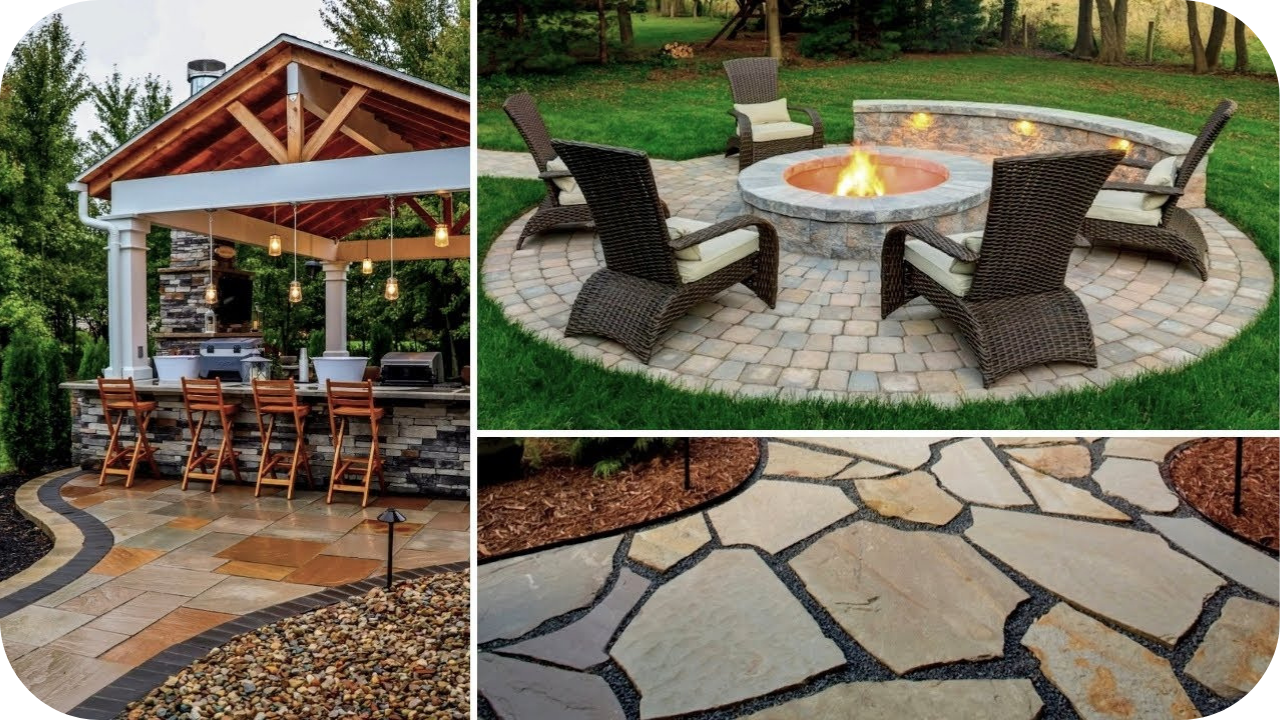
The best outdoor paving ideas start with the material, not the layout. Bluestone suits contemporary entertaining areas and high-traffic paths, travertine and limestone suit pool surrounds and courtyards where lighter tones keep the surface cooler underfoot, sandstone suits informal garden settings, and granite and porphyry suit driveways and areas taking heavy wear. Choose the stone first, then the pattern and the format.
Below are eighteen ideas grouped by what the space is actually for: entertaining and living, paths and gardens, and structure or level changes. Each one notes the setting it suits best, so the list works as a shortlist rather than a gallery.
How to choose the right paving for your space
Work through five decisions before you look at a single photo, because they narrow the material list faster than anything else.
- What the area is for: an entertaining terrace, a garden path, a pool surround and a driveway all carry different loads and need different formats and thicknesses.
- Exposure: full sun, deep shade under trees, or regular wetting near a pool or downpipe. Shaded and damp areas hold moisture and organic growth, which affects both the finish you choose and how often you clean it.
- Finish and surface texture: honed, sawn, flamed, tumbled and sandblasted surfaces all feel and behave differently underfoot, particularly when wet. Textured finishes are the usual choice around water.
- Colour and heat: darker stone absorbs more heat and gets warmer underfoot in an Australian summer. Lighter tones are the safer pick for barefoot areas.
- Size of the space: larger-format pavers with fewer joint lines make a small courtyard read as bigger, while smaller units and cobbles suit curves, edging and detail work.
Which paving material suits which space

Natural stone is not interchangeable. The table below sets out how the common paving stones behave and where they are typically used in Australian landscaping, so you can match material to application before you shortlist a look. Most backyards come down to a shortlist of five or six natural stone paving materials, and the differences between them are practical rather than decorative.
| Material | Look | Typically used for | Australian climate notes |
|---|---|---|---|
| Bluestone | Deep grey to blue-grey, even tone | Entertaining areas, paths, steps, pool surrounds | Darker tone absorbs heat, so consider it carefully for barefoot areas |
| Travertine | Warm cream to walnut, subtle banding | Pool surrounds, courtyards, alfresco floors | Light tones stay cooler underfoot; porous, so sealing is usually recommended |
| Limestone | Pale cream to soft grey, fine grain | Patios, courtyards, indoor and outdoor floor runs | Light and cool underfoot; porous, so sealing is usually recommended |
| Sandstone | Warm honey, gold and rust tones | Informal garden paving, paths, steps | Naturally textured surface suits garden settings |
| Granite | Dense, speckled, cool grey to black | Driveways, high-traffic paths, edging | Very hard wearing, holds colour under UV |
| Porphyry | Grey, brown, red and purple variation | Driveways, cobbled paths, edging | Hard wearing with a naturally varied surface |
| Marble | Pale, veined, refined | Feature paving, courtyards, alfresco floors | Softer than granite, better suited to lower-traffic areas |
| Crazy paving | Irregular flagstone pieces, mosaic joint lines | Organic garden areas, informal terraces, paths | Available across several stone types, so climate behaviour follows the stone |
Paving ideas for entertaining and living areas

These six ideas suit the part of the backyard that carries furniture, foot traffic and gatherings. Format and flatness matter more here than anywhere else.
1. Large-format stone patio
A large-format patio uses pavers of a single generous size laid in a simple grid, so the surface reads as one continuous plane. Fewer joint lines make the area feel calmer and larger, and a level, well-prepared base is what keeps a large-format layout looking right over time. Limestone and bluestone both work in this format.
Best for: open entertaining terraces and modern homes where the paving should recede behind the furniture and planting.
2. An alfresco floor that continues the indoor line
Running the same stone, or a closely matched tone, from the indoor floor out through the alfresco doors makes both rooms feel bigger. The trick is matching format and joint width as closely as the two surfaces allow, and planning the threshold and drainage detail early. Travertine and limestone are common choices because they are available in tones that sit comfortably indoors and out.
Best for: homes with wide sliding or bifold doors where the indoor and outdoor floors meet at one level.
3. Circular fire pit surround
A circular paved area around a fire pit sets the seating arrangement before any furniture arrives. Radial or concentric layouts need cutting, so expect more wastage than a straight grid, and darker stone reads well against flame and holds its look through ash and soot. Cobblestones also suit a circular setting because their small format follows the curve without heavy cutting.
Best for: larger backyards with a defined lounge or gathering zone away from the house.
4. Outdoor kitchen and BBQ paving
Paving under an outdoor kitchen takes grease, oil, food and dropped hardware, so the practical choices matter more than the aesthetic ones. A denser stone and a sealed surface make cleaning easier, and running the paving under the full working zone rather than stopping at the bench line avoids an awkward edge in a busy area.
Best for: built-in BBQ zones and outdoor kitchens that get regular use.
5. Mixed deck and stone transition
Combining timber decking with a stone terrace lets you use each material where it performs best: decking over uneven or sloping ground, stone across the flat, high-wear zone. Keep the transition deliberate, with a clean shared edge line and both surfaces finishing at the same level, so the change reads as a design decision.
Best for: sloping blocks and backyards where one level sits noticeably higher than another.
6. Mediterranean-style courtyard
A Mediterranean-style courtyard pairs warm-toned stone with rendered walls, gravel edges and planting in pots. Travertine and limestone in tumbled or brushed finishes give the softened surface this look depends on, and irregular or mixed-size layouts suit it better than a strict grid.
Best for: enclosed courtyards, side gardens and homes with rendered or painted masonry.
Paving ideas for paths, gardens and small spaces

These six ideas cover the connecting parts of a garden, where paving guides movement rather than holding furniture.
7. Stepping stones through lawn or gravel
Stepping stones are individual pavers set with planted or gravel gaps between them, so the path reads as part of the garden rather than a hard surface cut through it. Spacing is the whole job: set the stones to a comfortable stride so people walk on them rather than beside them. Beyond a simple garden path, the same spacing rule carries the other common ways to use stepping stones, including lawn runs, water feature surrounds and entry approaches.
Best for: lawns, side paths, garden beds and routes that get light foot traffic.
8. Cobblestone path or edging
Cobblestones are small, thick stone units that follow curves without cutting, which makes them the practical choice for winding paths and for edging where a larger paver would need to be trimmed. Used as a border around a patio or driveway, a cobbled band frames the main paving and hides the edge detail, which is why cobblestone paving tends to be specified for the edges and curves of a project rather than its open areas.
Best for: curved paths, driveway borders, garden bed edging and heritage-style frontages.
9. Crazy paving for informal areas
Crazy paving lays irregular flagstone pieces in a mosaic pattern with varied joint lines, giving a relaxed surface that suits organic garden shapes. It takes more skill and more time to lay than a regular format because each piece is fitted individually, and wastage is higher. Bluestone, limestone, travertine and porphyry all break into the irregular pieces crazy paving needs, so the choice between them comes down to tone and how the surface weathers.
Best for: informal terraces, garden paths and areas with curved or irregular boundaries.
10. Checkerboard stone and grass
A checkerboard alternates square pavers with planted squares of lawn or groundcover, breaking up a hard surface while keeping a walkable route through it. It needs a regular grid and consistent paver size to work, and the planted squares need enough soil depth to stay healthy under foot traffic.
Best for: side courtyards, entry approaches and areas where you want to reduce paved surface without losing access.
11. Stone edging for garden beds
A single row of stone set flush with the lawn defines a garden bed and gives the mower a clean line to run along. It is one of the cheapest ways to make an existing garden look finished, and it stops mulch and soil washing across the lawn after rain.
Best for: established gardens where the beds have no clear edge.
12. Small-courtyard layouts that read larger
In a small courtyard, larger pavers laid with tight joints and run in the longer direction of the space make the area feel bigger, while busy patterns and small units do the opposite. Keeping the paving one tone and letting the planting carry the colour has the same effect. These are the moves that make stone paving in small outdoor areas read as deliberate rather than cramped.
Best for: inner-city courtyards, balconies at ground level and narrow side returns.
Paving ideas for structure, level changes and drainage

These six ideas deal with the parts of a backyard that are not flat, and with water.
13. Rustic stone steps between levels
Stone steps in a garden work best when the tread is generous and the rise is low, which suits a landscape setting better than the tighter proportions used indoors. Solid stone treads suit a rustic look, while paved treads over a built base give a more contemporary line. Consistent riser height across the full flight is the safety detail that matters most.
Best for: sloping backyards and any change of level more than one step deep.
14. Retaining wall with integrated seating
Building a wall at seat height along one edge of a paved area gives permanent seating and holds back the level change at the same time. Matching or deliberately contrasting the wall stone with the paving is a design decision worth making early, and it is easier to resolve when the stone walling and the pavers are shortlisted together rather than in sequence. The wall itself needs proper engineering for the load it retains.
Best for: terraced backyards and entertaining areas cut into a slope.
15. Water feature surround
Paving around a pond, water bowl or spillway is regularly wet, so the finish choice matters more than in a dry area. Textured surfaces such as tumbled, sandblasted or flamed finishes are the usual choice near water, and highly polished surfaces are generally avoided. The same reasoning drives the best stone for pool coping and paving, where the surface is wet and barefoot at the same time.
Best for: courtyard water features, ponds and any paving that stays damp.
16. Zen garden with stone insets
A gravel or raked-stone garden with a small number of large stone insets creates a quiet, low-planting space that needs very little maintenance. The insets work as both stepping points and visual anchors, so fewer and larger is better than many and small.
Best for: shaded side gardens, meditation areas and spaces where planting struggles.
17. Permeable paving for drainage
Permeable paving lets water pass through the surface or the joints into the ground below instead of running off it, which helps on blocks with clay soils or limited stormwater capacity. It depends as much on the base build-up and joint filling as on the paver itself, so it is worth confirming the full system with your installer and checking your council’s stormwater requirements before you commit.
Best for: driveways, large paved areas and sites with drainage or runoff constraints.
18. Mosaic or inlaid feature detail
A small inlaid panel, a contrasting band, or a mosaic centrepiece set into an otherwise plain paved area gives the surface a focal point without complicating the whole layout. Keep it to one moment rather than several, and set it where people naturally stop, such as an entry threshold or the centre of a courtyard.
Best for: entries, courtyards and any paved area that needs one point of interest.
Which paving pattern should you use?
For strength, herringbone is the strongest common paving pattern, because the interlocking layout spreads load across neighbouring units instead of concentrating it in straight joint lines. That is why it is the usual choice for driveways and any surface taking vehicle weight. For everything else, the pattern is mostly a visual decision balanced against how much cutting it creates.
| Pattern | Look | Best used for | Cutting and wastage |
|---|---|---|---|
| Stack bond | Grid, joints aligned both ways | Modern terraces, large-format paving | Low |
| Running bond | Offset rows, like brickwork | Paths, narrow spaces, informal areas | Low |
| Herringbone | Interlocking 45 or 90 degree zigzag | Driveways, high-load areas | Higher at edges |
| Basketweave | Paired units alternating direction | Heritage settings, small courtyards | Low to moderate |
| Random ashlar | Mixed paver sizes in a fitted layout | Courtyards, natural stone terraces | Moderate |
| Opus pattern | Repeating multi-size module | Larger terraces needing visual variety | Moderate |
| Crazy paving | Irregular pieces, mosaic joints | Informal gardens, curved areas | Highest |
Pattern also changes how a space reads. Running a bond pattern along the long axis of a narrow courtyard stretches it, and a busy pattern in a small area makes it feel smaller.
What affects the cost of a paved area?
Supply cost varies by material, format and quantity, and installation is usually the larger share of a paving budget. These are the factors that move the number most.
- Material and format: stone type, paver size and thickness all affect supply cost, and larger or thicker units cost more to handle and lay.
- Wastage from the layout: circular, curved and crazy paving layouts generate more offcuts than a straight grid, so you buy more square metres than you cover.
- Base and drainage preparation: excavation, compaction, drainage and the bedding build-up are usually the biggest hidden cost, particularly on clay soils or sloping ground.
- Edges, steps and level changes: every step, edge restraint and coping run adds cutting, detailing and labour.
- Access and delivery: narrow side access, no vehicle access to the rear, or a first-floor terrace all add handling time.
Supply pricing moves with material, format and quantity, so a square metreage against a shortlist is what turns a rough budget into a real one. Most buyers narrow that shortlist with stone samples before they commit to a quantity.
Next steps for your paving project
Narrow the list to two or three materials, then order samples and look at them on site in real light before you commit, because stone colour shifts noticeably between a showroom and a backyard. Bring your square metreage and the intended use of the space, and the material choice usually resolves quickly from there.
Frequently asked questions
1. What is the best outdoor paving for Australian conditions?
There is no single best material, because the right choice depends on the application. Bluestone and granite handle high traffic and hold up well outdoors, travertine and limestone are popular for pool surrounds and barefoot areas because lighter tones stay cooler underfoot, and porphyry and granite are common driveway choices for their hardness. Match the stone to the load, the exposure and how the space is used.
2. Is it cheaper to lay pavers or concrete?
Poured concrete usually has a lower upfront cost per square metre than natural stone paving, particularly across large open areas. Paving costs more to supply and lay, but individual units can be lifted and replaced if something is damaged or if services need to be accessed, which concrete does not allow without cutting. Compare the two over the life of the surface rather than on the initial quote alone.
3. What is the cheapest paving option?
Within natural stone, the cheapest outcome usually comes from a simple layout in a standard size, laid in a straight pattern with minimal cutting. Reducing paved area also helps: stepping stones, a checkerboard of paving and lawn, or gravel with stone insets all cover a space for less than fully paving it. The material choice matters, but layout complexity and site preparation often move the total more.
4. Which paving pattern is the strongest?
Herringbone is the strongest common paving pattern. The interlocking layout transfers load sideways into neighbouring pavers rather than allowing movement along continuous straight joints, which is why it is standard for driveways and vehicle areas. Stack bond, with joints aligned in both directions, is the weakest under load and is better kept to pedestrian areas.
5. Can you lay pavers directly on dirt?
Laying pavers straight onto soil is not recommended for anything you want to last. Without a compacted base and a bedding layer, pavers settle unevenly, move underfoot and hold water, and the surface goes out of level within a season or two. Stepping stones set into lawn are the one common exception, and even those benefit from a compacted bed underneath.
6. How thick should outdoor pavers be?
Thickness depends on the load the area carries and on the specific stone, so it should be confirmed against the product specification rather than assumed. As a principle, pedestrian areas such as patios and paths need less thickness than driveways and any surface taking vehicle weight, and the base build-up under the paver has to be specified to match. Check the thickness listed for the product you are considering before ordering.
7. Does natural stone paving need sealing?
Most porous natural stones, including travertine, limestone and sandstone, are usually sealed outdoors to reduce staining and make cleaning easier. Denser stones such as granite absorb less and may not need it. Sealing is a maintenance step rather than a one-off: sealing paving stones for outdoor conditions works on a cycle set by exposure and traffic, not as a single job at installation.
8. What paving suits a small backyard?
Larger-format pavers in a single tone, laid with tight joints and run along the longer axis, make a small backyard read as bigger. Fewer joint lines and less pattern variation reduce visual clutter, and keeping the paving neutral lets planting carry the colour. Avoid busy patterns and small units, which break the surface into pieces and shrink the space.



